
You want the cleanest air for your home. Air purifying Activated Carbon stands out in 2026 because it traps odors, VOCs, and allergens fast. Just look at these numbers:
Statistic | Value |
|---|---|
Homes with three allergens at elevated levels | |
Indoor organic pollutants vs. outdoor | 2–5x higher |
Asthma odds with high allergens | +81% |
Activated carbon works by grabbing harmful particles with its tiny pores, making your air safer and fresher.
Key Takeaways
Activated carbon air purifiers effectively trap odors, VOCs, and allergens, making your home air cleaner and fresher.
Choosing the right air purifier can significantly reduce allergy triggers and harmful pollutants, improving your family’s health and comfort.
Regularly replace activated carbon filters every 6 to 12 months to maintain optimal air quality in your home.
Why Choose Air Purifying Activated Carbon
How Activated Carbon Cleans Air
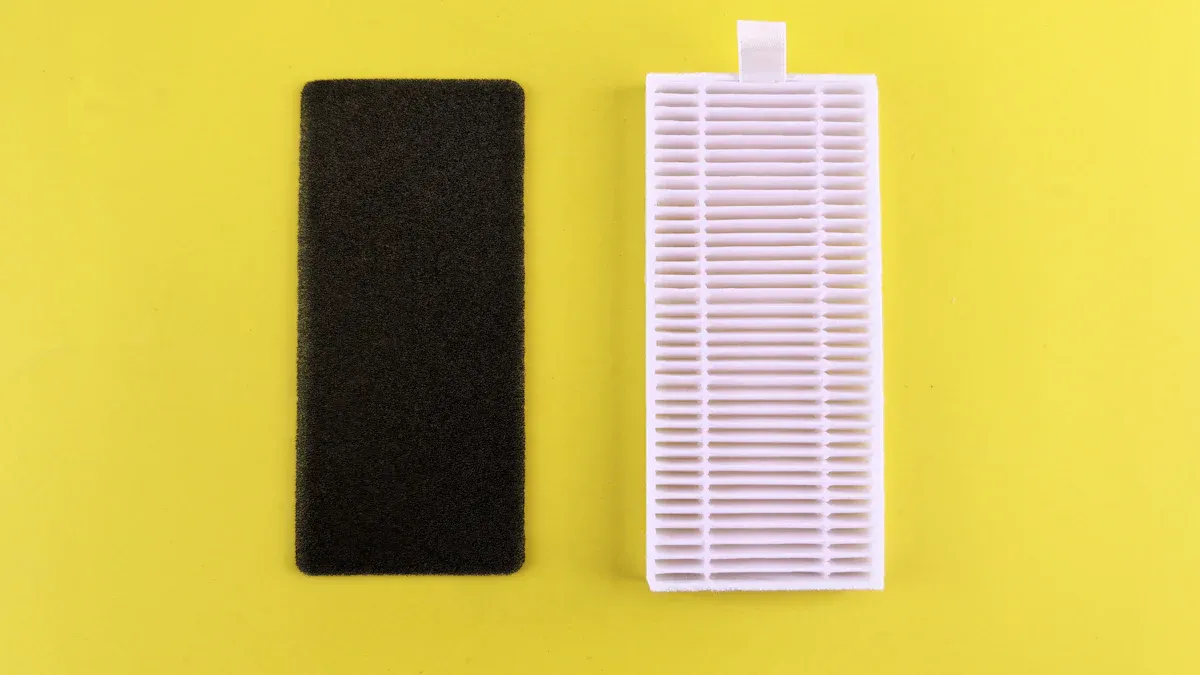
You might wonder how Air purifying Activated Carbon actually works. It’s pretty cool! This material has millions of tiny pores. These pores grab and hold onto bad stuff in your air. Scientists call this process “adsorption.” That means the molecules stick to the surface of the carbon, not just get soaked up inside. Here’s what makes it special:
It traps odors by catching smelly molecules in its pores.
It removes harmful gases, like VOCs, by sticking them to its surface.
It has a huge inner surface area, so it can grab lots of pollutants at once.
You get cleaner, fresher air in your home because Air purifying Activated Carbon doesn’t just cover up smells—it actually removes them.
Benefits for Home Environments
You want your home to feel safe and smell fresh. Air purifying Activated Carbon helps you do that. It targets many common indoor pollutants. Check out this table to see what it can handle:
Source Type | Examples of Pollutants |
|---|---|
Natural Sources | Radon, dust, mold spores |
Human-made Sources | Volatile Organic Compounds (VOCs) from furniture, carpets, and insulation |
Combustion Sources | Carbon monoxide and particulates from gas stoves, heaters, and tobacco smoke |
With Air purifying Activated Carbon, you can cut down on allergy triggers, strong odors, and even dangerous gases. You get peace of mind knowing your air is cleaner for your family and pets. Plus, you don’t have to worry about lingering smells from cooking or smoke. That’s a win for any home!
Top 10 Air Purifiers for 2026
Blueair Blue Pure 311i Max – Best Overall
You want a purifier that works hard and looks good. The Blueair Blue Pure 311i Max does both. It covers medium to large rooms and uses a combination of washable pre-filter, particle filter, and Air purifying Activated Carbon. You get smart features, quiet operation, and strong airflow. The app lets you control everything from your phone.
Here’s a quick look at the specs:
Specification | Value |
|---|---|
387 sq. ft. | |
CADR | 250 CFM |
Noise Level | 40.2 – 59.5 dBA |
Filter Life | 6-9 months |
Power | 30W |
Performance Ratings | 9.4/10 |
The 311i Max scored high in independent tests. In a 320 sq. ft. room, it reduced PM2.5 from 109.1 to 4.7 µg/m³—a 96% improvement. Even in a bigger 560 sq. ft. room, it improved air quality by 89%.
User Tip: You’ll love the quiet operation at low speeds, but you might notice a buzzing sound on max. Some users mention a faint chemical smell at first, but it fades.
Strengths:
Low energy use
Smart app and air quality sensor
Washable pre-filter
Great for medium to large spaces
Weaknesses:
High filter replacement cost
Not the best for strong odors or VOCs
Buzzing noise at high speed
Austin Air HealthMate – Most Carbon Power
If you want the most powerful odor and chemical removal, the Austin Air HealthMate stands out. It packs a whopping 15 pounds of activated carbon—more than any other home purifier. This means it’s a top choice for removing VOCs, formaldehyde, and tough smells.
Removes VOCs, chemicals, gases, and odors
Combines activated carbon and zeolite for extra cleaning power
Works with a HEPA filter for dust and allergens
Certification | Description |
|---|---|
CSA/NRTL Approved | Meets top safety and performance standards |
Industry-Leading Testing & Validation | Removes 99.97% of airborne contaminants |
Clinical Trials | Tested by Johns Hopkins University and University of Washington |
You get peace of mind with its proven results and certifications. It’s a bit heavy, but you know you’re getting serious cleaning.
Coway Airmega AP-1512HH Mighty – Best for Allergies
Allergy season can be tough. The Coway Airmega AP-1512HH Mighty makes it easier. It uses a True HEPA filter and Air purifying Activated Carbon to trap dust, pollen, and pet dander.
Metric | Value |
|---|---|
Air Quality Improvement | 96% |
PM2.5 Reduction | From 113.8 to 4.7 µg/m³ |
Users say it works wonders for allergies. It’s quiet, reliable, and fits well in bedrooms or living rooms. You’ll notice less sneezing and stuffy noses.
True HEPA filter for allergens
Excellent performance in real rooms
Recommended by allergy sufferers
Airmega AP-1512HHS – Best for Smoke
Smoke from wildfires or cooking can fill your home fast. The Airmega AP-1512HHS clears smoke quickly. In lab tests, it removed all smoke from a glass box in just 18 seconds. That’s faster than most competitors.
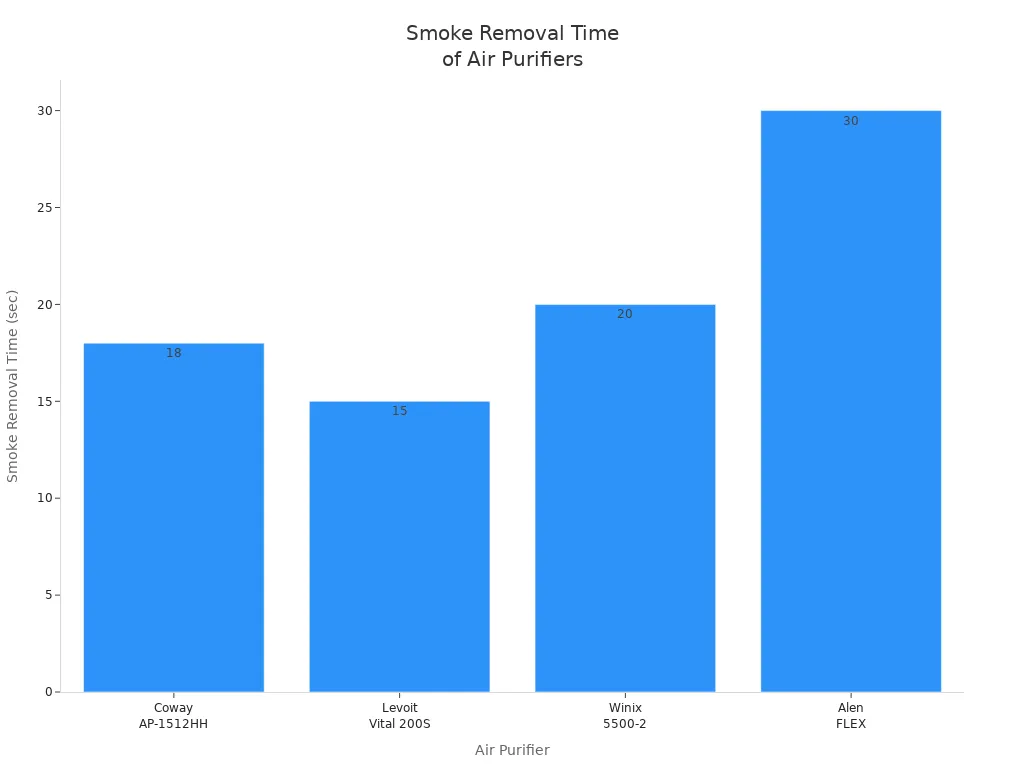
Clears smoke faster than Winix 5500-2 and Alen FLEX
Good for light to moderate smoke
Not the best for heavy smoke or strong odors
If you need fast smoke removal, this purifier is a smart pick.
Blueair Classic Pro – Advanced Filtration
You want advanced technology? The Blueair Classic Pro brings it. It uses HEPASilent™ dual filtration, capturing 99.97% of particles as small as 0.01 microns. PhotonPure™ lighting reduces up to 91% of viruses and bacteria on the filter.
Quiet and energy-efficient
Captures ultra-fine particles
Reduces germs on the filter
Specification | Value |
|---|---|
Energy Consumption | 15-90 Watts |
Noise Level | 32-62 dB(A) |
This purifier works well in homes where you want both clean air and less noise.
Dyson Purifier Cool TP07 – Best Smart Features
If you love smart gadgets, the Dyson Purifier Cool TP07 is for you. It comes with an intuitive app, remote control, and advanced filtration. You can check air quality and adjust settings from anywhere.
Feature | Impact |
|---|---|
Intuitive app | Monitor and control air quality remotely |
Remote control | Adjust settings with ease |
Advanced filtration | Removes harmful particles and gases |
Oscillation | Spreads clean air around the room |
Quiet operation | Great for bedrooms and quiet spaces |
Note: The TP07 is slower at cleaning a room than some cheaper models. It took 62 minutes to clear a test room, but it’s still a solid choice if you want smart features and style.
Rabbit Air A3 – Best for Customization
You want a purifier that fits your needs and your style. The Rabbit Air A3 lets you customize filters for pets, odors, germs, or even green tea. You can also change the front panel to match your room.
Customization Option | Description | Impact |
|---|---|---|
Customizable Filters | Choose for pets, odors, germs, or green tea | Targets your air quality issues |
Mood Light Setting | Adjustable light | Adds style, not function |
Magnetic Front Panel | Easy to swap | Matches your decor |
This purifier is perfect if you want something unique and effective.
Levoit Core 400S – Best Value
You want great air cleaning without breaking the bank. The Levoit Core 400S gives you that. It covers 403 sq. ft., has a CADR of 260 CFM, and filter costs stay low ($50–$70 per year).
Cleans a 320 sq. ft. room by 96%
Improves air quality by 91% in larger rooms
Affordable filters
You get strong performance and value for your money.
Winix 5500-2 – Best for Odors
Odors from pets, cooking, or smoke can linger. The Winix 5500-2 tackles them with a four-stage system, including a granular activated carbon filter and PlasmaWave technology.
Feature | Winix 5500-2 | Competitors |
|---|---|---|
Purification Stages | Four stages including activated carbon | Varies by model |
Odor Removal Technology | Granular activated carbon filter | Often less effective |
Additional Technology | PlasmaWave technology | Not all models have this feature |
Filter Types | Pre-filter, HEPA, Carbon | Varies by model |
Maintenance is easy. Genuine filters cost about $50 per year, and you can rinse the carbon filter every three months.
Honeywell HPA300 – Best for Large Rooms
If you have a big living room or open space, the Honeywell HPA300 is a strong choice. It covers up to 465 sq. ft. and has high CADR ratings for dust, smoke, and pollen.
Room size coverage: up to 465 sq. ft.
AHAM Dust CADR: 320
AHAM Smoke CADR: 300
AHAM Pollen CADR: 300
Consumer reports say it moves a lot of air, but its cleaning power is best for rooms up to 300 sq. ft. It’s a reliable pick for large bedrooms or family rooms.
Comparison Table of Top Picks
Features Overview
You want to see how these air purifiers stack up, right? Here’s a handy table that shows you the main features, room coverage, and yearly cost for some of the best models. This way, you can spot the differences at a glance and pick what fits your home.
Model | Annual Cost | Key Features | |
|---|---|---|---|
GermGuardian CDAP4500BCA | 150 | $144 | Great for dust, pollen, smoke; app control |
Honeywell HPA120W | 150 | $65 | Affordable, simple, easy to use |
Blueair Blue Pure 311i+ Max | Large | $135 | Dirt sensor, multiple speeds, portable |
Blueair Blue Pure 211+ | Large | $212 | Strong performance, heavier, fewer features |
Coway Airmega ProX | Extra-Large | $258 | Best for big rooms, auto-sensor, heavy |
AirDoctor AD5500 | N/A | $342 | High speed, powerful, but noisy and pricey |
Tip: If you want a purifier for a small bedroom, go for a compact model. For open spaces, choose one with “large” or “extra-large” coverage.
Pros and Cons Summary
Every air purifier has its strengths and weaknesses. Check out this quick summary to help you decide what matters most for your home.
Model | Pros | Cons |
|---|---|---|
Puroair 240 | Small, three-stage filter, certified | Loud, small filter, tricky indicator light |
Dyson Purifier Cool Gen 1 | Sleek, air quality sensor | No app, remote issues, odd fan style |
Blueair Blue Signature | Stylish, app control | Short, hard-to-use controls |
Coway Airmega 50 | Works well for size, built-in sensor | Confusing air quality colors |
Sharp FPF30UH | Cheap, good for small rooms | Not for big rooms, basic design |
IQAir CG Series XE | Powerful, catches toxic gases, smart app | Noisy on high, expensive |
You can use these tables to match your needs with the right purifier. Want quiet? Look for models with low noise. Need smart features? Pick one with app control.
How We Selected the Best
Testing Methods
You want to know how we picked the top air purifiers, right? We used a hands-on approach to make sure you get the facts. Here’s what we did:
We tested each purifier in a smoke chamber. This let us see how well each one removed fine and coarse particles, like PM2.5 and PM10.
We used a GreyWolf PC3500 Particle Counter to measure how many particles stayed in the air.
We checked how loud each purifier was at different speeds.
We looked at energy use, price, and special features.
We gave each purifier a score out of 10 for every category. Then, we combined those scores for a final ranking.
This way, you can trust that every Air purifying Activated Carbon model on our list works well in real homes.
Selection Criteria
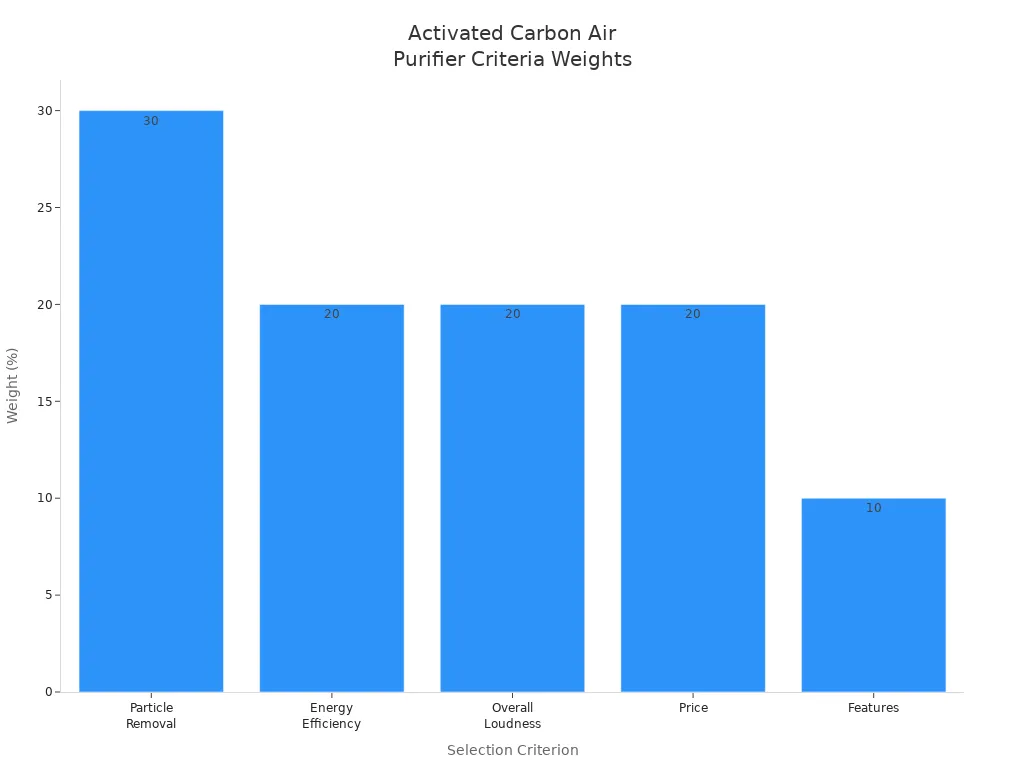
You care about what matters most. We ranked each purifier using clear criteria. Here’s how we weighed each factor:
Criterion | Weight (%) |
|---|---|
Particle Removal | 30 |
Energy Efficiency | 20 |
Overall Loudness | 20 |
Price | 20 |
Features | 10 |
You get the best picks for clean air, quiet operation, and smart value. We made sure to focus on what helps you breathe easier at home.
You want the best air for your home. For allergies, try Coway Airmega AP-1512HH Mighty. For smoke, pick Airmega AP-1512HHS. Large rooms? Go with Honeywell HPA300. Activated carbon removes many harmful substances:
Description | |
|---|---|
Odors | Unpleasant smells from cooking and organic sources |
VOCs | Volatile organic chemicals that can be harmful to health |
Radon | A radioactive gas that can accumulate indoors |
Benzene | A solvent that can cause health issues |
Nitrogen dioxide | A gas that can contribute to respiratory problems |
Chlorine | A chemical that can irritate the respiratory system |
Herbicides and pesticides | Chemicals that can have harmful effects on health and the environment |
Check the comparison table and tips above to find the right fit for your needs and budget!
FAQ
How often should I replace the activated carbon filter?
You should change the filter every 6 to 12 months. Check your air purifier’s manual for the best schedule.
Can activated carbon remove pet odors?
Yes! Activated carbon traps pet odors fast. You will notice fresher air in your home after a few hours.
Do air purifiers with activated carbon help with allergies?
Absolutely. These purifiers catch allergens like dust and pollen. You will breathe easier and sneeze less.