
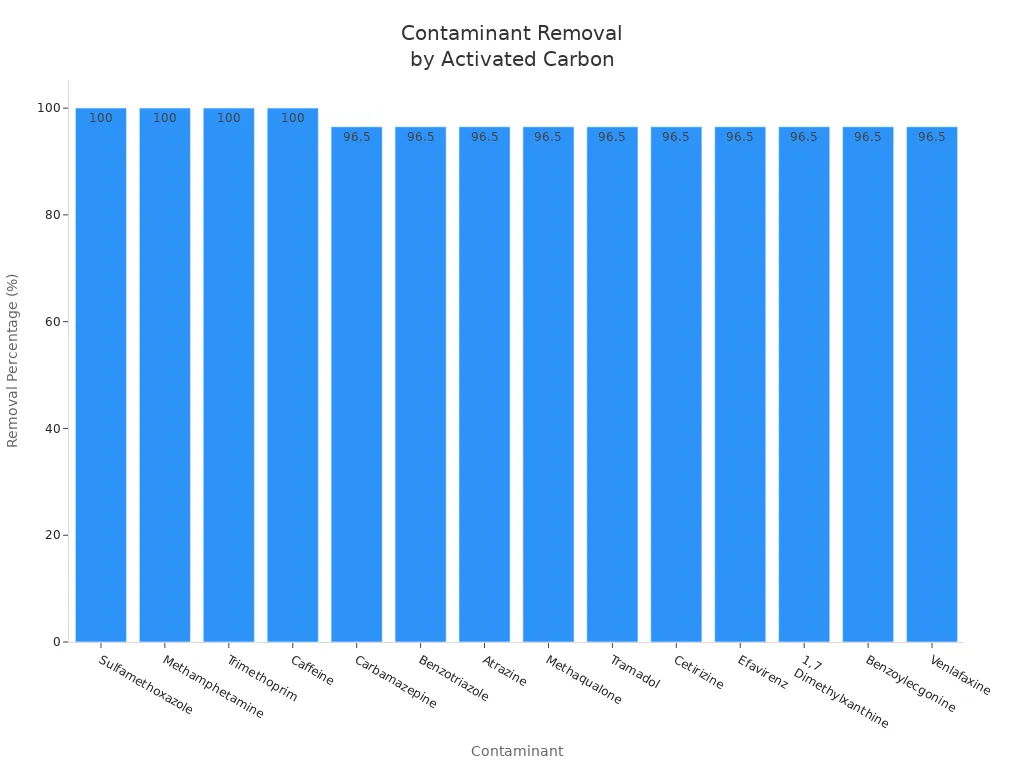
You can use Powder Activated Carbon to remove harmful substances from water and air with impressive speed. This fine powder has a huge surface area that lets it trap contaminants quickly. Studies show that it removes more than 90% of volatile organic compounds and chlorine, and almost 100% of drugs like sulfamethoxazole and caffeine.
Contaminant Type | Removal Percentage |
|---|---|
Volatile Organic Compounds | > 90% |
Chlorine Residuals | > 90% |
Sulfamethoxazole | ~100% |
Caffeine | ~100% |
Key Takeaways
Powder Activated Carbon (PAC) effectively removes over 90% of harmful substances from water and air, making it a powerful tool for purification.
The fine particle size of PAC increases its surface area, allowing for faster adsorption of contaminants compared to larger carbon types.
PAC can be made from various materials like coal, wood, and coconut shells, each offering unique properties for specific applications.
Using PAC in water treatment can significantly improve taste and odor, achieving up to 95% removal of pollutants with proper dosing and contact time.
While PAC is cost-effective and reusable, proper handling and disposal are essential to ensure safety and environmental protection.
Powder Activated Carbon Overview
What Is Powder Activated Carbon
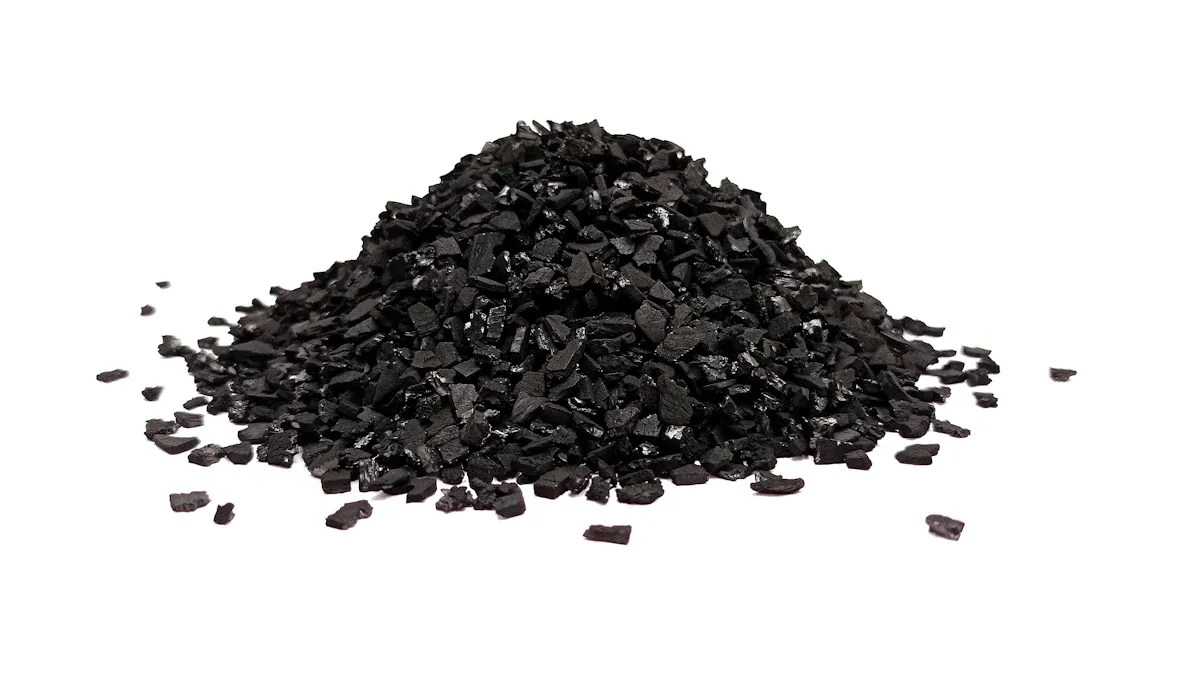
You can think of Powder Activated Carbon as a very fine black powder that works like a sponge for chemicals. The particles are tiny—usually less than 100 micrometers in diameter. This small size gives the powder a huge surface area. You get more places for contaminants to stick. Most manufacturers make this powder by activating sawdust or other carbon-rich materials with chemicals. You add it directly to water or another liquid, then remove it by filtration.
Tip: The smaller the particle, the faster it can trap unwanted substances.
Here is a table that shows the main characteristics of this material:
Characteristic | Description |
|---|---|
Particle Size | Very small, usually less than 100 μm in diameter. |
Preparation Method | Generally prepared by chemical activation from sawdust. |
Adsorption Advantage | Higher adsorption rates due to less diffusional resistance compared to larger particles. |
Application | Used for adsorption from the liquid phase, added directly to the solution and separated by filtration. |
Key Features and Properties
You will notice that Powder Activated Carbon stands out because of its high porosity and special pore structure. The powder contains three main types of pores:
Micropores (<2 nm): These trap small molecules like gases and dissolved organic compounds.
Mesopores (2–50 nm): These hold larger molecules, such as organic contaminants, heavy metals, and some medicines.
Macropores (>50 nm): These help move molecules into the smaller pores where most adsorption happens.
The distribution of these pores is important. Most of the internal surface area comes from micropores. This means you get strong adsorption for many pollutants.
Here are some key points about how the fine powder works compared to granular activated carbon:
Powder Activated Carbon has a much smaller particle size than granular activated carbon.
The smaller size gives you a greater surface area.
More surface area means you can remove more impurities in less time.
You can see how well this powder works for different pesticides:
Pesticide | |
|---|---|
Diazinon | 4.1 – 7.9 |
Isoxathion | 3.9 – 5.8 |
Malathion | 1.2 – 1.7 |
Tolchlofos-methyl | 1.4 – 1.4 |
Note: Even though the rates for some pesticides are low, the powder removes many other contaminants very efficiently.
You can rely on Powder Activated Carbon for rapid and efficient removal of a wide range of pollutants. The fine particle size and high porosity make it a top choice for water and air purification.
Composition and Production
Raw Materials (Coal, Wood, Coconut Shells)
You can make Powder Activated Carbon from several natural sources. The most common raw materials include coal, coconut shells, and wood. Each material gives the carbon different properties and uses.
Coal holds the largest share in the market, making up about 48.5% of production. You often choose coal because it is easy to find and costs less.
Coconut shells are popular for their strong micropore structure. You use them when you need high-purity carbon, such as in food or medicine.
Wood has a smaller market share. You see it mostly in food and beverage processing.
The choice of raw material affects how the carbon works. Here is a table that shows the main properties and uses for each type:
Raw Material | Properties | Applications |
|---|---|---|
Coal | Fast filtration, strong adsorption, good for removing color and odor, durable | Sewage treatment, power plants, chemical industries |
Wood | Large and medium pores, strong at removing color, durable | Food, beverage, medicine, tap water, sugar, sewage |
Coconut Shell | Fast filtration, strong adsorption, good for removing color and odor | Food, beverage, medicine, alcohol, raw material cleaning |
Tip: If you need to remove tiny molecules or want high purity, coconut shell carbon is a smart choice.
Activation Process
You create Powder Activated Carbon through a special process called activation. This process gives the carbon its high surface area and many pores.
First, you heat the raw material to 400-600℃ in a low-oxygen space. This step, called carbonization, forms a carbon-rich base.
Next, you activate the carbon by heating it to 600-1200℃ with steam or chemicals. This step opens up more pores and removes unwanted substances.
After activation, you measure the porosity to check the surface area.
The final product can now trap toxins and other molecules very well.
You can use steam activation to create more pores with high heat. Chemical activation uses substances like phosphoric acid at lower temperatures. Chemical activation often gives lower yields, but it can make special types of carbon.
Note: The yield of activated carbon depends on the raw material. For example, corncob and similar materials give yields from about 10% to 43%. Some woods and plant parts can give even higher yields.
How It Works

Adsorption Mechanism
You can think of adsorption as a process where unwanted substances stick to the surface of Powder Activated Carbon. When you add this carbon to water or air, the tiny pores inside each particle trap contaminants. This happens because the molecules in the water or air are attracted to the carbon’s surface. The process works best for organic compounds with complex shapes and low solubility. These molecules bond to the carbon through electrostatic forces and chemical interactions.
Here is a table that breaks down how adsorption works:
Aspect | Description |
|---|---|
Contaminants get trapped on the carbon surface through a physical process. | |
Pore Size Distribution | Micropores catch small molecules, mesopores hold medium-sized ones, and macropores move molecules to the right spots. |
Affinity | Organic compounds with complex structures and low solubility stick to the carbon surface due to special attractions. |
You will notice that the different pore sizes play a big role. Micropores, which are less than 2 nanometers wide, trap the smallest molecules. Mesopores, between 2 and 50 nanometers, capture medium-sized molecules. Macropores, larger than 50 nanometers, help move molecules into the smaller pores where most adsorption happens.
When you compare Powder Activated Carbon to other types, you see some clear differences:
Powder Activated Carbon removes color from liquids very well. For example, it can remove over 94% of color from leachate with just a small dose.
Granular activated carbon works better for removing larger molecules, like those that affect chemical oxygen demand.
The difference comes from the size and number of pores in each type. Powder Activated Carbon has more mesopores, which are perfect for smaller molecules.
Why Fine Powder Matters
The fine powder form of activated carbon gives you several important benefits. The small particle size means you get a much larger surface area. This lets the carbon trap more impurities in less time. When you use smaller particles, the adsorption rate for organic impurities goes up quickly.
Smaller particles lead to faster adsorption because they have more surface area.
When you reduce the average particle size by four times, the ability to remove cloudy substances (turbidity) doubles or triples.
If you make the particles thirty times smaller, the turbidity removal increases six to eight times.
You also get better mixing and contact with the liquid or gas you want to clean. The powder spreads out quickly and evenly, so every part of the water or air touches the carbon. This means you can treat the whole batch faster and more completely.
Feature | Description |
|---|---|
High Adsorption Efficiency | Fine particles work fast and hold a lot of impurities. |
Good Dispersibility | The powder spreads out quickly, so it touches all the contaminants and works more efficiently. |
You get immediate and strong contact with the water or air.
You can control the amount you use very precisely.
This makes Powder Activated Carbon ideal for jobs where you need quick and thorough purification.
Tip: If you need to clean water or air quickly, using a fine powder form of activated carbon gives you the best results.
Uses of Powder Activated Carbon
Water Treatment
You can use Powder Activated Carbon in water treatment plants to make water safer and better tasting. This material helps you remove bad tastes, odors, and many harmful chemicals. When you add the right amount, you can remove up to 95% of certain pollutants. The best results come when you use 10–20 mg/L of carbon and let it mix for 15–30 minutes. If you add a coagulant, you can boost the removal rate to over 93%.
Here is how you might see it used in water plants:
Application | Description |
|---|---|
Improves taste and smell by trapping unwanted compounds. | |
Removal of Organic Chemicals | Removes many organic pollutants, making water cleaner and safer. |
Operational Requirements | Needs the right contact time and should not mix with some chemicals during treatment. |
You can expect 84–91% removal of suspended solid micropollutants.
The system works best with fresh doses of carbon.
Tip: Always check the contact time and dose for the best results in your water treatment process.
Air Purification
You can use this carbon to clean the air in your home, office, or even your car. It traps gases and odors that can make you sick or uncomfortable. For example, it removes volatile organic compounds (VOCs) from paints and cleaning products. It also gets rid of odors from cooking, pets, and smoke. You can find it in air purifiers, HVAC systems, and even car filters.
Removes VOCs that can cause headaches and breathing problems.
Neutralizes odors from daily activities.
Adsorbs harmful gases like carbon monoxide and formaldehyde.
Works with HEPA filters to reduce allergens from gases.
Common uses include:
Standalone air purifiers for homes and offices.
HVAC systems to improve indoor air quality.
Industrial filters in factories and labs.
Automotive air filters to keep car cabins fresh.
Food and Beverage Applications
You can rely on this carbon to keep your food and drinks safe and tasty. It removes color, unwanted flavors, and trace chemicals from water used in making beverages. This helps you get the right taste every time. In edible oil processing, it removes harmful compounds and odors, making oils safer and better for cooking.
Eliminates unwanted flavors and organic impurities.
Ensures the correct flavor and quality in both alcoholic and non-alcoholic drinks.
Purifies edible oils by removing color and harmful substances.
Here are some safety and quality standards you should know:
Standard/Certification | Description |
|---|---|
Safe for use with drinking water and food. | |
Particle Size | Consistent size (10–50 microns) for reliable performance. |
Effectiveness | Removes over 99% of pesticide residues and microbes for high safety. |
Note: Always choose food-grade carbon that meets safety standards for the best results in food and beverage processing.
Pros and Cons
Advantages
You will find many benefits when you use Powder Activated Carbon for cleaning water and air. Here are some of the main advantages:
You can save money because PAC costs less than many other purification materials. The price usually ranges from $1.20 to $2.00 per kilogram, while granular activated carbon can cost over $6 per kilogram.
You can reuse PAC until it reaches its limit. This helps you use less material and lower your costs by up to 20%.
You get fast and flexible treatment. PAC works well in both water and air systems. You can add it when you need it and remove it after use.
You can remove many types of contaminants. PAC traps odors, colors, heavy metals, and chemicals. It also improves taste and removes harmful substances.
You can combine PAC with other treatment methods. This helps protect biological systems from toxic shocks and makes the whole process more reliable.
You can treat large amounts of water or air quickly. The fine powder spreads out and works fast.
Tip: Using cleaner energy during production can lower costs and reduce environmental impact.
Limitations
You should also know about some challenges when you use Powder Activated Carbon:
You may have trouble separating the fine powder from water or air after treatment. This often means you need extra steps like filtration or sedimentation.
You must handle used PAC with care. It can hold dangerous substances, so you need to follow rules for safe disposal or regeneration.
You may see lower performance if many different contaminants are present. Some substances can compete for the same spots on the carbon, making it harder to remove your target pollutant.
You face challenges with disposal and recycling. Incineration and landfill can harm the environment. Regeneration methods often use a lot of energy and can damage the carbon, making it less effective for reuse.
Note: Always check local rules for handling and disposing of spent PAC to keep your process safe and eco-friendly.
You can rely on Powder Activated Carbon for fast and effective removal of contaminants in water, air, and food processing. This material works best when you need rapid treatment and precise dosing. Always check key parameters before choosing a product:
Parameter | Typical Range | Application Tip |
|---|---|---|
Particle Size | 90% <75 µm | Finer particles clean faster but filter harder |
Iodine Number | 800–1,200 mg/g | Higher values trap more chemicals |
Ash Content | 2–8% | Lower ash suits food and beverage uses |
You should select PAC when you want quick results and easy mixing, especially for short-term purification jobs.
FAQ
What is the difference between Powder Activated Carbon and Granular Activated Carbon?
You use Powder Activated Carbon for quick, one-time treatments. The powder has tiny particles and works fast. Granular Activated Carbon has larger pieces. You use it in filters for longer-term cleaning.
Is Powder Activated Carbon safe for drinking water?
Yes, you can use food-grade Powder Activated Carbon to clean drinking water. Always check for certifications like NSF/ANSI 61. This ensures the product meets safety standards.
How do you remove Powder Activated Carbon after treatment?
You remove the powder by filtration or sedimentation. Water treatment plants use special filters. At home, you can use a fine filter or let the powder settle, then pour off the clean water.
Can you reuse Powder Activated Carbon?
You can reuse it a few times, but its power drops each use. Most people use fresh powder for best results. Used carbon may hold trapped pollutants, so handle it with care.