
The previous two articles established one key conclusion: sugar liquor decolorization is not simply about having more micropores, but about the ability of mesopores to adsorb large color molecules. This raises another practical question: mesoporous structure cannot be seen with the naked eye, and conventional testing methods cannot fully reveal it. So, how can buyers evaluate the decolorization performance of activated carbon for sugar refining?
The answer is one of the key performance indicators widely used in the sugar industry: Molasses Number.
In this article, we will cover the final and most practical part of activated carbon selection for sugar refining: which performance indicators to evaluate, how to match different carbon types with processing conditions, and how to prevent potential quality risks. By the end, you will have a practical framework for selecting activated carbon for sugar decolorization.
1. Key Performance Indicator: Molasses Number vs. Caramel Decolorization
Two decolorization indicators are frequently mentioned in the activated carbon market, but they are often misunderstood or even treated as interchangeable. In reality, they evaluate different adsorption characteristics.
What Is Molasses Number?
Molasses Number is determined using a standardized molasses solution. Molasses is a by-product of sugar production and contains various large, colored organic compounds, including melanoidin-like substances, caramel color compounds, and polymerized polyphenols.
Because these compounds are more representative of the complex color bodies encountered in actual sugar refining, the test provides useful information about an activated carbon’s ability to remove large and complex color molecules. It is therefore commonly considered an important reference parameter when evaluating activated carbon for sugar refining, particularly its mesopore development.
A simple way to understand it is:
The Molasses Number test is similar to simulating actual sugar liquor decolorization on a laboratory scale.
Under commonly used Calgon-based testing systems in China, a higher Molasses Number generally indicates a more developed mesoporous structure and stronger adsorption performance toward larger color molecules.
What Is Caramel Decolorization?
Caramel decolorization is tested using a relatively simple caramel solution. Because the test system contains fewer and more uniform color compounds, it is often used for preliminary screening and rapid comparison.
However, its composition is less representative of the complex color bodies present in real sugar liquors.
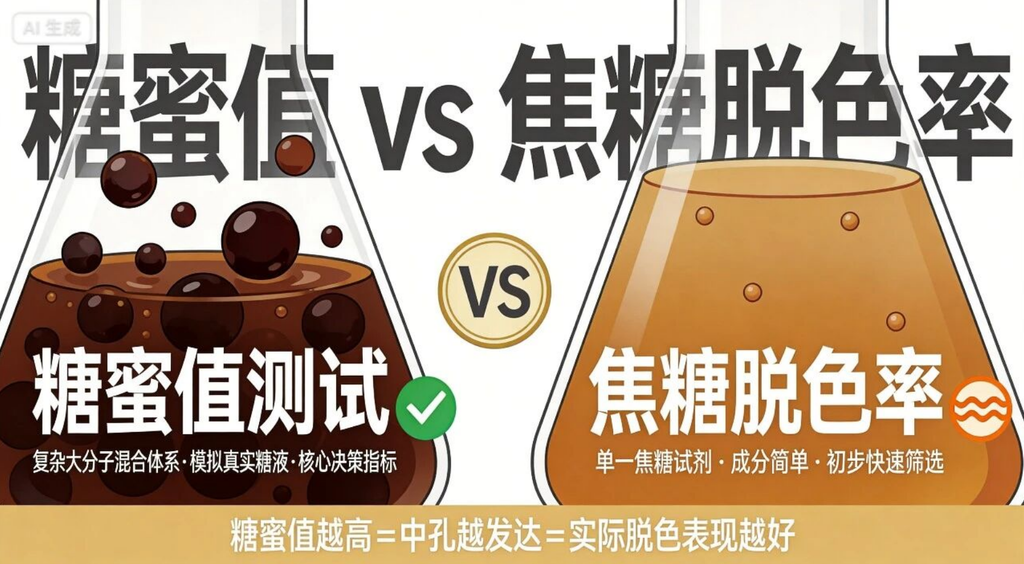
In simple terms:
- Caramel decolorization: A preliminary reference for quickly screening and comparing products.
- Molasses Number: A more important decision-making parameter, particularly for sucrose and beet sugar refining applications.
When activated carbons have similar iodine numbers, a carbon with a higher Molasses Number may provide stronger decolorization performance for sugar liquor because of its more suitable mesoporous structure. This is a direct reflection of the “mesopore-driven” principle discussed in the previous article.
Important Note: Always Align the Testing Method
China currently does not have a single unified national standard specifically defining Molasses Number testing, so industry testing may refer to methods based on Calgon/PACS systems.
This creates a common purchasing risk: different suppliers may report Molasses Number values obtained using different test methods, reference materials, or calculation systems. Two numbers may look comparable while actually representing different test conditions.
When comparing suppliers, buyers should confirm at least the following points:
- Which testing standard or method was used?
- Are the molasses solution concentration and measurement wavelength consistent?
- Are the products being compared based on the same carbon type and activation process? For example, directly comparing a phosphoric-acid-activated wood-based carbon with a modified coal-based carbon solely by Molasses Number may have limited practical significance.
- Is the numerical direction of the indicator the same?
The fourth point is particularly important.
Under some Calgon/PACS-based systems, the reported value is interpreted as an adsorption/decolorization value, where a higher value indicates stronger performance. By contrast, some Norit-based European methods may report a residual value, where a lower value indicates better performance.
Therefore, asking whether “80 or 300 is better” without first confirming the test method can lead to a completely wrong conclusion. Comparing numbers from different standards without aligning the testing methodology is essentially comparing measurements made with different scales.
2. Practical Selection: How to Match Wood-Based, Coal-Based, and Granular Activated Carbon
Once the key indicators are understood, the next step is to match the activated carbon with the plant’s process configuration, decolorization requirements, equipment, and cost objectives.
The main types of activated carbon used for sugar decolorization can generally be divided into three categories.
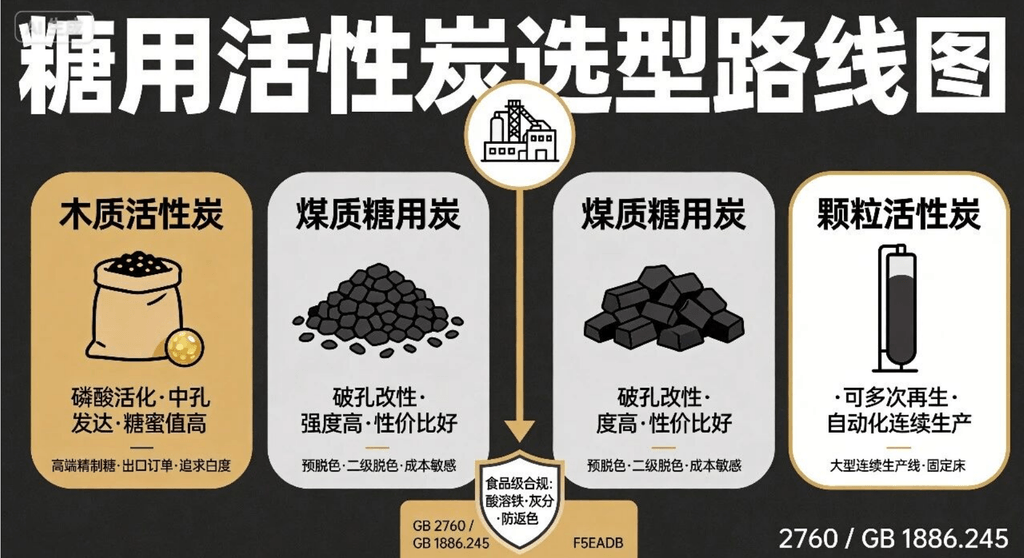
2.1 Food-Grade Wood-Based Activated Carbon — A Preferred Choice for High Decolorization Requirements
Typical applications:
High-purity refined sugar production requiring excellent color removal; large modern continuous production lines using granular activated carbon; and batch decolorization processes using powdered activated carbon.
Key advantages:
Wood-based activated carbon produced through phosphoric acid activation generally has a highly developed mesoporous structure. Its relatively high Molasses Number reflects its strong adsorption capacity for large color molecules and makes it particularly suitable for demanding sugar decolorization applications.
Application recommendation:
If your products target high-purity white sugar, refined caster sugar, or export markets with strict color specifications, the stable decolorization performance of wood-based activated carbon can help reduce process fluctuations and improve product consistency.
2.2 Coal-Based Activated Carbon for Sugar Refining — A Cost-Effective Option
Typical applications:
Cost-sensitive projects, coarse decolorization of remelted raw sugar, or applications where moderate final color requirements are acceptable.
Key advantages:
Cost efficiency: Conventional coal-based activated carbon tends to have a higher proportion of micropores. However, specially modified coal-based carbon can be engineered to increase its mesopore proportion and improve adsorption of larger color molecules.
Although its performance may be somewhat different from that of wood-based activated carbon in certain sugar decolorization applications, its lower raw-material cost makes it suitable for pre-decolorization or secondary decolorization.
High mechanical strength: Coal-based activated carbon generally offers good mechanical strength, resulting in lower attrition during transportation and dosing. Its suitable particle structure can also support efficient filtration and help reduce the overall activated carbon cost per ton of sugar.
Application recommendation:
A practical cost-control strategy is to use a two-stage decolorization system: coal-based carbon for primary decolorization + wood-based carbon for final polishing.
The coal-based carbon handles a large portion of the initial color load, while a smaller amount of wood-based carbon provides final color removal and helps achieve the required product color specification.
This combination can reduce overall treatment costs while maintaining the required decolorization performance, provided that the process is properly validated through laboratory and pilot testing.
2.3 Granular Activated Carbon — For Carbon Column Systems
Typical applications:
Large-scale, modern continuous sugar refining lines equipped with fixed-bed carbon columns.
Key advantages:
Both wood-based and coal-based granular activated carbon can be used in suitable fixed-bed systems and may be thermally regenerated and reused multiple times, depending on the carbon grade, contaminants, process conditions, and regeneration system.
This makes granular activated carbon suitable for long-term continuous operation and highly automated production, while reducing manual carbon handling and operating requirements.
Application recommendation:
Granular activated carbon systems generally require higher initial equipment investment. However, for large-volume continuous sugar refineries, evaluating the total decolorization cost per ton of sugar over the entire operating cycle may show economic advantages compared with single-use powdered activated carbon.
Therefore, activated carbon selection should not be based solely on the purchase price per ton. Buyers should also consider:
- Carbon consumption and regeneration losses
- Labor requirements
- Equipment investment
- Filtration efficiency
- Regeneration frequency
- Production downtime
- Overall operating cost per ton of sugar
3. A Critical Requirement That Should Not Be Overlooked: Preventing Color Reversion
The previous sections focused on decolorization performance, but there is another hidden risk that can undermine an otherwise successful treatment process: color reversion.
Because sugar processing is a food-related application, activated carbon used for sugar refining must comply with the applicable food-contact and food-additive requirements. For products used in China, relevant requirements include GB 2760 and GB 1886.245, Food Safety National Standard — Food Additive: Activated Carbon, with strict control of parameters such as ash content and acid-soluble iron.
Why Is Color Reversion a Serious Risk?
If activated carbon contains excessive iron or other undesirable inorganic impurities, the problem may not be immediately visible during the decolorization stage.
However, during subsequent storage, residual metal ions and other impurities may contribute to chemical reactions that gradually cause the sugar liquor or sugar product to develop color again.
The result can include:
- Increased color in the treated sugar liquor
- Reduced whiteness of refined white sugar
- Failure to meet product color specifications
- Quality instability during storage
- Potential rejection of finished batches
The risk is particularly difficult to detect because color reversion may only become apparent after the product has been stored, warehoused, or even shipped. By that stage, correcting the problem can be costly and difficult.
Practical Quality-Control Measures for Purchasing
When purchasing activated carbon for sugar decolorization, buyers should take several preventive measures:
- Request third-party test reports and pay particular attention to food-grade parameters such as acid-soluble iron, ash content, chloride, and other applicable specifications.
- Retest samples from the first shipment from a new supplier rather than relying solely on the supplier’s COA.
- Conduct laboratory-scale decolorization tests before placing large-volume orders. After treatment, allow the sample to stand for approximately 48 hours and monitor for color reversion before scaling up the process.
- Evaluate the carbon under actual process conditions, including dosage, contact time, temperature, filtration conditions, and sugar liquor characteristics.
In other words, excellent adsorption performance alone is not enough. If the activated carbon does not meet the required food-grade specifications and process-quality requirements, its decolorization performance cannot compensate for the resulting quality risks.
Conclusion: Evaluate the Carbon as a Complete System
Selecting activated carbon for sugar liquor decolorization should never be reduced to a single number such as iodine value or purchase price.
A reliable selection process should consider the relationship between:
Molasses Number → Mesopore Structure → Color Removal → Carbon Type → Process Configuration → Food-Grade Quality → Color-Reversion Risk → Total Cost of Treatment
For demanding sugar refining applications, the most appropriate carbon is not necessarily the product with the highest iodine number or the lowest price. It is the grade whose pore structure, decolorization performance, physical properties, food-grade quality, and process compatibility match the actual operating conditions.
By aligning the testing method first, comparing equivalent indicators, validating performance through laboratory trials, and checking critical quality parameters before large-scale purchasing, sugar manufacturers can make activated carbon selection more scientific, reduce process risks, and achieve more consistent decolorization results.