
You use coal based activated carbon to clean water or air. This material has very small holes that catch things you do not want. Coal is a great source for making activated carbon. It makes strong and porous structures. Most activated carbon in the world comes from coal.
Almost two thirds of activated carbon is made from coal. This is why it is important to learn how it is made and why it is special.
Key Takeaways
Coal-based activated carbon is a strong cleaning tool. It helps clean water and air.
It can hold many harmful chemicals and gases. It also traps heavy metals well.
Making it uses carbonization and steam activation. This process makes tiny holes in the carbon. These holes help it clean better.
Coal is cheap and easy to find. This makes it a common choice for making activated carbon.
Quality control is very important when making activated carbon. It keeps the product safe and working well.
Activated carbon comes in two main types. Granular is used for a long time. Powdered is used for quick fixes.
Using coal-based activated carbon helps make water and air safer. Many industries use it for this reason.
Recycling used activated carbon saves money. It also helps cut down on waste in the environment.
Coal Based Activated Carbon Overview
Definition and Main Function
Coal-based activated carbon is a strong cleaning helper. It has lots of tiny pores that trap things you do not want. People use it to take out bad stuff from water, air, and in factories. Its high adsorption capacity lets it catch many chemicals, gases, and even heavy metals.
Coal-based activated carbon is used in many places. You find it in water treatment plants, air cleaners, and food factories. The table below shows how different industries use it:
Application | Market Share (%) |
|---|---|
34 | |
Air Purification | 15 |
Food and Beverage Processing | 16 |
Automotive Applications | 12 |
Pharmaceutical and Medical | 14 |
Other Applications | 9 |
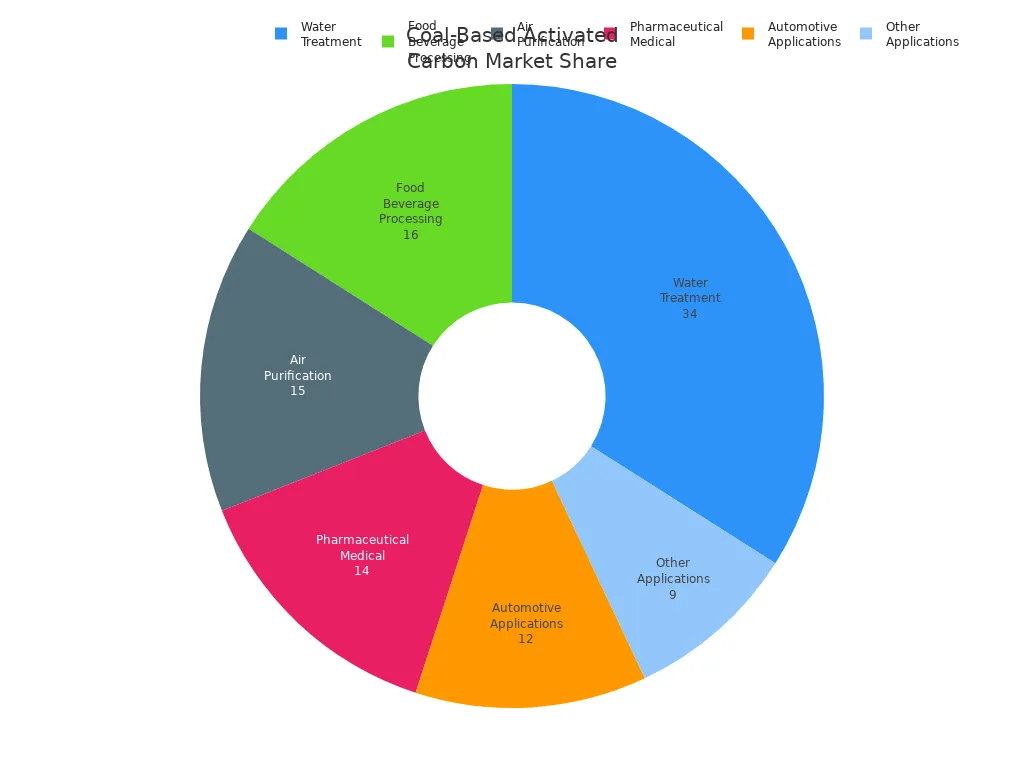
Water treatment uses the most coal-based activated carbon. Air cleaning and food factories also use a lot. This shows it helps keep our world clean and safe.
Coal as a Feedstock
Coal is the main source for making activated carbon because it works well. Coal has a lot of carbon, which helps make strong and porous material. When you heat coal without oxygen, it forms many pores. These pores help catch unwanted things.
Coal-based activated carbon can remove organic pollutants, heavy metals, and gases. The table below compares its adsorption ability to other types:
Type of Activated Carbon | Adsorption Capacity Description |
|---|---|
Coal-based Activated Carbon | High adsorption capacity for a wide range of substances, effective in removing organic pollutants, heavy metals, and gases. |
Bone-based Activated Carbon | Targeted adsorption capabilities, better for specific organic molecules, but generally lower overall capacity for a broad spectrum of pollutants. |
Coal has more good points. It is easy to find and costs less than other sources. The table below lists some reasons why coal is a good choice:
Characteristic | Description |
|---|---|
Adsorption Capacity | Brown coal has high adsorption capacity, sometimes better than other activated carbons. |
Specific Surface Area | You can treat coal to make its surface area bigger, so it adsorbs more. |
Carbonization Effects | More carbonization makes bigger pores, which trap more things. |
Pore Structure | Coal waste has good pore systems, so it is great for making carbon sorbents. |
Cost-Effectiveness | Coal is cheap and easy to get, so it keeps costs low. |
Application Versatility | You can use coal-based activated carbon in water, air, and many other cleaning jobs. |
Tip: If you pick coal-based activated carbon, you get something strong, low-cost, and useful in many ways.
Coal-based activated carbon is good for many cleaning jobs. Its special features and easy supply make it a smart pick for many people and companies.
Production Process
You can learn how coal based activated carbon is made by looking at each step. Every step changes the product and helps it clean water and air.
Pyrolysis and Char Formation
Carbonization Without Oxygen
First, you get the raw coal ready. You crush, screen, and dry the coal. This removes water and dirt. It also makes the coal pieces the right size. Then, you press the coal powder into a shape with a binder. This keeps the coal together and makes it strong for the next steps.
The most important step comes after that. You heat the shaped coal where there is no oxygen. This is called carbonization. The heat breaks down the coal and takes out things that are not carbon. You use different temperatures for different results.
Temperature Range (°C) | Description |
|---|---|
<700 | Low temperature, early stage of carbonization. |
700–900 | Medium temperature, more carbon forms. |
1000–1500 | High temperature, changes carbon to a stronger form. |
1600–1900 | Very high temperature, makes graphite-like carbon. |
You finish pyrolysis at about 1000°C. Higher heat makes the carbon structure stronger and more ordered. This step makes a hard, black material called char. Char is used to make activated carbon.
Types of Coal Used
You can use different kinds of coal to make activated carbon. Bituminous coal is used the most. It makes strong, porous activated carbon. This is good for granular activated carbon. Sub-bituminous coal and lignite are also used. These types give you more options and let you make activated carbon for many uses. The activation process gives all these coals a large surface area. This helps with adsorption.
Steam Activation
Creating Pores and Surface Area
You take the char and heat it again. This time, you add steam or carbon dioxide. This is called steam activation. The steam reacts with the carbon and burns away some parts. This makes lots of tiny holes, called pores, inside the carbon.
How you activate the char changes the size and number of pores. Some ways make mostly micropores, which are very small. Other ways make both micropores and mesopores, which are a bit bigger. The type of coal you use also changes the pore structure. For example, bituminous coal usually gives you more micropores.
Steam activation has been used for almost 100 years. It is a trusted way to make activated carbon with the right pore structure for good adsorption. More pores mean a bigger surface area. A large surface area lets the activated carbon catch more unwanted things. This is why advanced coal-based activated carbon works so well for cleaning.
Quality Control
You need to check every step to make sure you get good activated carbon. You look at the raw coal before you start. You watch the process closely and check things like temperature and time. After making the activated carbon, you test each batch to see if it meets the standards.
Quality Control Measure | Description |
|---|---|
Raw Material Inspection | You check every batch of coal to make sure it meets the rules. |
Production Process Monitoring | You set clear rules and watch important details in real time to keep things stable. |
Finished Product Inspection | You test every batch of activated carbon to make sure it is good enough for use. |
Note: Careful quality control helps you get activated carbon that works the same way every time. This means you can trust it for water, air, and industrial cleaning.
You can see that every step in the process is important. Picking the right coal, making pores, and checking quality all help make activated carbon that cleans well and works every time.
Properties and Forms
Physical Properties
Surface Area and Porosity
Activated carbon works well because it has a big surface area and lots of pores. The surface area shows how much space is there to trap things. Most coal based activated carbon has a surface area between 600 and 1200 square meters per gram. Some special kinds can reach up to 1140 m²/g. Others may be lower if made differently. The tiny holes, called micropores and mesopores, help make the surface area bigger. These pores let activated carbon catch and hold many pollutants.
The surface area can be from 465 to 1140 m²/g, depending on how it is made.
Granular activated carbon usually has 600-1200 m²/g.
Particle Size
The size of the particles changes how you use activated carbon. There are two main types: granular and powdered. Granular activated carbon has bigger particles, from 0.2 to 5 millimeters. Powdered activated carbon has very small particles, less than 0.18 millimeters. The particle size affects how fast activated carbon works and how easy it is to use.
Here are some common physical properties:
Property | Value |
|---|---|
1100 – 1200 | |
Apparent Density (lb/ft³) | 28-30 |
Hardness (ASTM D-3802) | 98 |
Chemical Properties
Adsorption Capacity
Activated carbon can trap many chemicals because it has a large surface area and special pores. The bigger the surface area, the more it can adsorb. The type of pollutant matters too. Non-polar substances stick better to the non-polar surface of activated carbon. If you want to catch polar substances, you can treat the surface to make it more selective. Particle size, pore structure, and surface chemistry all help activated carbon work well.
Non-polar or low-polar pollutants are easier to remove.
You can change the surface to target certain chemicals.
Purity
Purity is important for sensitive uses. Coal-based activated carbon usually has ash between 5% and 15%. This means it is less pure than coconut shell activated carbon, which has less than 3% ash. If you need very pure activated carbon, you might pick another type. For most cleaning jobs, coal-based activated carbon works well.
Type of Activated Carbon | Ash Content | Purity Level |
|---|---|---|
Coal-Based Activated Carbon | 5%-15% | Lower purity, higher ash content |
Coconut Shell Activated Carbon | <3% | High purity, low ash content |
Forms of Coal-Based Activated Carbon
Granular Activated Carbon (GAC)
Granular activated carbon has bigger particles. You use it in systems that filter water all the time. It is strong and can be cleaned and used again. GAC works well for removing organic compounds and keeps the pressure drop low in filters.
Powdered Activated Carbon (PAC)
Powdered activated carbon has very small particles. You use it for quick or emergency treatments, like cleaning up spills. PAC adsorbs pollutants fast but is usually used once and not easy to clean for reuse. It is flexible and responds quickly to changes in water or air quality.
Characteristic | Powdered Activated Carbon (PAC) | |
|---|---|---|
Particle Size | 0.2 to 5 mm | Less than 0.18 mm |
Application | Continuous filtration | Batch or emergency treatment |
Regeneration | Can be reused | Usually single-use |
Adsorption Capacity | High for organics | Rapid adsorption |
Mechanical Durability | Strong | Less durable |
Pressure Drop | Low | Higher |
Flexibility | Long-term use | Quick response |
Tip: Use granular activated carbon for long-term jobs. Pick powdered activated carbon for fast, flexible treatment.
Comparison with Other Activated Carbons
Coal-Based vs. Wood-Based
Coal-based activated carbon and wood-based activated carbon are both used to clean water and air. They are made from different things. Coal-based activated carbon comes from coal like anthracite or lignite. Wood-based activated carbon is made from wood waste or fruit shells. Coal-based activated carbon is made using high heat, usually between 800 and 1000°C. Wood-based activated carbon uses lower heat, around 500 to 800°C.
Here is a table that shows the main differences:
Feature | Coal-based Activated Carbon | Wood-based Activated Carbon |
|---|---|---|
Raw Materials | Made from coal (anthracite, lignite) | Made from wood waste, fruit shell |
Production Process | High temperature carbonization (800-1000°C) | Lower activation temperature (500-800°C) |
Pore Structure | Microporous, 800-1200 m²/g surface area | More pores, 500-1000 m²/g surface area |
Adsorption Properties | Strong for gases (VOCs, H2S) | Better for liquids |
Physical Characteristics | High mechanical strength, high density | Lower hardness, fast adsorption rate |
Application Field | Industrial waste gas, air purification | Drinking water, food decolorization |
Cost-effectiveness | More cost-effective for industrial use | Popular for renewable material |
Coal-based activated carbon is strong and dense. It works well in factories and for cleaning waste gas. Wood-based activated carbon is good for cleaning drinking water and food. It is made from renewable materials, so it is better for the environment.
If you care about nature, wood-based activated carbon is made from things that can grow again. Coal-based activated carbon comes from mining coal, which cannot be replaced. Mining coal uses more energy and can hurt the land. It also makes more carbon emissions. Wood-based activated carbon is better for the planet, but cutting down trees can cause problems too.
Coal-Based vs. Coconut-Based
Coconut-based activated carbon is also common. The biggest difference is in the size of the pores. Coconut shell activated carbon has lots of tiny pores. Coal-based activated carbon has bigger pores.
Here is a table that shows the differences:
Type of Activated Carbon | Pore Structure Description |
|---|---|
Coconut Shell Activated Carbon | Mostly micropores, fine and dense pore space |
Coal-Based Activated Carbon | More mesopores and macropores, larger bubbles |
Coconut-based activated carbon is best for removing small things from water. You see it in water filters and air cleaners. Coal-based activated carbon is better for factories and big jobs. Its bigger pores help clean larger molecules and gases. It works well when you need fast flow and high capacity.
Unique Advantages
Coal-based activated carbon has special benefits for factories:
It stays strong at high temperatures, even above 400°C.
It has great mechanical strength, so it works in tough jobs.
You can reuse it by regenerating it, which saves money.
It is a cheap choice for big cleaning jobs, like treating gases.
You can use it in many places, such as waste gas cleaning and making chemicals.
It lasts a long time, so factories do not stop often.
It works well every time, even in hard conditions.
It can clean many kinds of pollutants, so it is flexible.
It helps factories run smoothly and reliably.
Tip: If you want a strong, reusable, and reliable material for cleaning in factories, coal-based activated carbon is a smart choice.
Applications of Coal Based Activated Carbon
Coal-based activated charcoal helps clean water, air, and many things you use. You can find it in homes, factories, food, and medicine. Let’s see how people use it in different ways.
Water Purification
Activated charcoal is used to make drinking water safe. It traps chemicals and bad tastes in the water. It helps lower organic compounds and chlorine. It also helps take out lead from old pipes. Some special types, like FILTRASORB® GAC, can remove tough chemicals like PFAS, PFOA, and PFOS. These chemicals are dangerous and can hurt your health. Activated charcoal also takes out benzene and trichloroethylene, which are risky. You can find it in home water filters and big city water plants.
Activated charcoal lowers organic compounds and chlorine.
It helps remove lead and bad tastes.
It can trap chemicals like benzene and trichloroethylene.
Tip: If you want safe water, activated charcoal is a good choice for cleaning it.
Air and Gas Treatment
Activated charcoal is used to clean the air and gases in factories. It removes harmful gases and bad smells. In air conditioners, it helps filter out radon and odors. It also takes out hydrogen sulfide from natural gas. This keeps the air fresh and safe in homes, offices, and factories.
Here is a table that shows where coal-based activated charcoal is used for air and gas cleaning:
Application Type | Description |
|---|---|
Gas Phase Purification | Cleans gases in many factory jobs. |
Potable Water Purification | |
Wastewater Purification | Cleans dirty water before it goes back to nature. |
Aquarium/Pond Water Purification | Keeps water safe for fish and plants in tanks and ponds. |
Note: You can use activated charcoal for both air and water cleaning. It works well in many places.
Industrial Uses
Coal-based activated charcoal is important for cleaning in factories. You can find it in places that make food, drinks, and medicine.
Food and Beverage Processing
Activated charcoal is used to clean sugar, juices, and drinks. It takes out colors, smells, and unwanted chemicals. This makes food and drinks taste better and look clear. Many companies use it to keep their products safe and pure.
Pharmaceutical Applications
You see activated charcoal in medicine factories. It helps clean raw materials and finished drugs. It removes harmful chemicals and makes sure the medicine is safe. Some medicines even use activated charcoal to treat poisoning.
Activated charcoal is used to clean food, drinks, and medicine.
It helps keep products safe and pure for people.
If you work in a factory, you can trust activated charcoal for cleaning. It helps you follow safety rules and keeps your products high quality.
Environmental Impact and Innovation
Environmental Considerations
Making coal-based activated carbon can hurt the environment. The process uses a lot of energy from fossil fuels. This makes a lot of carbon emissions. There are other problems too:
The activation step lets out tiny dust into the air. These small particles can make it hard to breathe for people close by.
Factories make dirty water with bad chemicals. If this water is not cleaned, it can pollute rivers and lakes.
Solid waste like coal ash and slag is left behind. If workers do not handle this waste right, it can get into the ground and water.
Coal-based activated carbon helps clean water and air. But making it can cause pollution if not handled well.
Sustainable Production
Many companies want to make activated carbon in better ways. They are trying new ideas and changes:
Some companies use raw materials like coconut shells or bamboo. These plants grow back fast and help lower carbon emissions.
Greener ways to activate carbon are becoming more common. These new methods use less energy and make less pollution.
In Europe and North America, rules about pollution are getting tougher. Companies must follow these rules, so they use cleaner technology and better waste control.
If you care about the earth, pick activated carbon made with these new ways. This helps keep air and water clean and protects nature.
Recycling and Reuse
You do not always need to throw away used activated carbon. Recycling and reusing it saves money and helps the planet. Here is how recycling works:
Workers heat the used activated carbon in special ovens without oxygen. They use steam to help clean it.
The heat makes the trapped chemicals turn into gas or break down into char.
Any gases made are destroyed in a special burner.
Acid gases are cleaned out with a chemical scrubber.
The high heat and steam make the activated carbon able to catch pollutants again.
You can find recycling services that fit your needs. Recycling used carbon costs less than buying new. It also lowers the risk of pollution from throwing it away the wrong way.
When you recycle activated carbon, you help cut down on waste and keep the world cleaner. You also save money and follow safety rules.
Coal-based activated carbon helps keep water, air, and soil clean. It controls pollution from factories and removes heavy metals. It also helps get back useful chemicals. You can follow rules from groups like the EPA and FDA by using it. More people care about pollution, so the market keeps growing. New ways to make it are safer for the earth. Picking coal-based activated carbon helps make the world cleaner and healthier.