
Granular activated carbon is a special material. It helps remove bad chemicals from water or air. People make it from different things. Coal is the most common. It works well and does not cost much. Coconut shell is getting more popular. It can be used again and is very hard. Wood is used for some special jobs. You can see the main sources in the table below:
Raw Material | Market Share Description |
|---|---|
Coal | Coal is used the most because it is cheap and works well. |
Coconut Shell | Coconut shell is getting more popular. It is good for the planet and very hard. |
Wood | Wood is used for special needs. It is not used as much because there is not a lot of it and other choices are better. |
Key Takeaways
Granular activated carbon (GAC) helps clean water and air. It removes bad chemicals, so it is important for cleaning.
GAC comes from things like coal, coconut shells, and wood. Each material has special uses for different jobs.
GAC has many small holes in it. These holes catch dirty stuff by a process called adsorption. Adsorption can be physical or chemical.
You need to take care of GAC filters often. Change them every 3 to 12 months so they keep working well.
GAC filters make water taste and smell better. They take out chlorine and other bad things. This makes water safer and nicer to drink.
These filters are good for the planet and can be used at home or in factories. They do not put bad chemicals back into the earth.
GAC filters save money because you do not need to change them a lot. They also do not use electricity, so you save more money.
When picking a GAC filter, think about the size of the pieces, what it is made from, and what you need it for. This helps the filter work its best.
What is granular activated carbon
GAC composition and structure
Granular activated carbon comes from coal, coconut shells, or wood. Each material gives it different features. Coal-based GAC is good at taking out tiny pollutants. Coconut shell GAC has lots of small holes. This makes it great for cleaning water and gases. Wood-based GAC helps take color out of liquids. It is also safe to use.
GAC is made of small, hard grains. These grains have many tiny holes called pores. The pores make the surface area very big. This helps GAC trap more chemicals and dirt. GAC grains are between 0.2 mm and 5 mm wide. The table below shows how the source changes GAC:
Type of Activated Carbon | Hardness | Surface Area | Pore Sizes | Best Use |
|---|---|---|---|---|
Coconut Shell | High | High | Micro Pores | Drinking water, gas purification |
Wood | Medium | Medium | Mixed | Decolorizing, food processing |
Coal | Medium | High | Mixed | Water treatment, odor removal |
How GAC differs from other carbons
Granular activated carbon is not like other carbons. The main difference is the size of its grains. GAC has bigger grains than powdered activated carbon. This means GAC has less surface area. But it works better in filters where water or air keeps moving.
Here is a table to compare GAC and PAC:
Type of Activated Carbon | Particle Size (mm) | Surface Area Characteristics | Best For |
|---|---|---|---|
Granular Activated Carbon (GAC) | 0.2 – 5 | Lower surface area, larger particles | Continuous filtration systems |
Powdered Activated Carbon (PAC) | < 0.18 | Very high surface area, fine powder | Quick contaminant removal |
GAC gives steady cleaning and does not clog fast. PAC works quickly for small jobs but can block filters. GAC is better for long-term use in water and air filters.
Main uses of GAC
Granular activated carbon is used in many places. It cleans drinking water by taking out bad chemicals. It also traps gases and smells in air cleaners. Factories use GAC to clean dirty water and air. Food companies use it to take away bad tastes and smells.
Here are some common ways people use GAC:
Cleaning drinking water at home or in cities
Purifying air in homes, offices, and factories
Treating dirty water before it goes to rivers
Removing smells in food and drink making
Helping clean up the environment
GAC helps keep water and air safe. Its special structure makes it a top pick for many jobs.
How granular activated carbon works
Granular activated carbon helps clean water and air. It uses a process called adsorption. Adsorption pulls bad stuff out of liquids and gases. Each grain acts like a sponge with many tiny holes. These holes catch and hold onto pollutants. The way it works depends on the surface and structure of the carbon.
Adsorption process
Adsorption is how granular activated carbon removes chemicals. Molecules stick to the surface of the carbon grains. The surface attracts and holds them in place. The grains have a large surface area and many pores. This makes adsorption work really well. There are two main types of adsorption: physical and chemical.
Physical adsorption
Physical adsorption uses weak forces to pull pollutants in. These forces are called van der Waals or London dispersion forces. No chemical reaction is needed for this type. It works best when the surface area is big and pores are open. More pores mean more places for adsorption. Many chemicals, especially those without a charge, can be removed this way.
Physical adsorption is good for:
Taking out organic chemicals
Catching gases and smells
Cleaning up oil spills
Chemical adsorption
Chemical adsorption uses stronger forces. The carbon surface has special groups that react with pollutants. These groups can change the surface’s charge. This helps the surface attract certain chemicals even more. Chemical adsorption is important for removing metals and charged particles. The carbon forms a bond with the pollutant in this process.
Chemical adsorption helps with:
Removing heavy metals
Grabbing chlorine and disinfectants
Holding chemicals with a charge
Note: Both weak and strong forces help adsorption in granular activated carbon. Surface groups can change the charge. This helps the carbon grab more pollutants.
Filtration mechanism
Granular activated carbon does more than adsorption. It also works as a filter. When water or air moves through the carbon, grains trap dirt and big pieces. The size of the grains and spaces between them catch larger particles. The pores inside the grains grab smaller molecules by adsorption. This two-step process makes the filter strong.
Filtration Step | What Happens |
|---|---|
Particle Filtration | Grains trap dirt and large pieces |
Adsorption | Pores grab and hold small molecules |
Both steps work together to give you clean water or air. The filter removes things you see and things you cannot see.
Factors affecting GAC performance
Many things can change how well granular activated carbon works. You should think about these when using a filter.
Pore structure: Different pore sizes help remove different pollutants.
Water quality: The kind of water affects how well adsorption works.
Operating conditions: Contact time and flow rate are important for adsorption.
Smaller mesh sizes give more surface area and shorter paths for adsorption. Bigger mesh sizes are better for longer contact times.
Contact time and dosage: More time and the right amount of carbon help adsorption.
Flow rate control: Slower flow rates let adsorption work better.
Regeneration and replacement: Check and change the carbon to keep it working.
Granular activated carbon can stop working if there are too many pollutants. When the carbon is full, it cannot hold more. Natural organic matter can block the pores and make adsorption weaker. This happens in water plants, so the carbon must be replaced sometimes.
Key Findings | Description |
|---|---|
Pore Size Importance | Pores between 0.2–10 μm help bacteria stick and break down pollutants, making adsorption better. |
Bacterial Activity | Bacteria living in the carbon can help by breaking down chemicals. |
Dynamic Adsorption | Bacteria can help renew the carbon by cleaning the pores. |
You get the best results by picking the right pore size, keeping the flow steady, and changing the carbon when needed. Adsorption works best when you match the filter to your needs.
Granular activated carbon filter applications
Granular activated carbon helps clean water and air in many ways. You can use these filters at home, in factories, or in stores. They work quickly and fit into many water and air cleaning systems.
Water purification
You often see these filters in water cleaning systems. They help make water safe to drink and use.
Drinking water
You can put these filters in your whole-house system. They take out bad tastes, smells, and chemicals. They remove chlorine, lead, and organic matter. Your water tastes better and smells nice. These filters work faster than carbon block filters. You get clean water quickly. You find them in city water plants and home systems.
These filters remove:
Chlorine
Lead
Organic matter
Bad tastes and odors
Tip: To make your tap water taste and smell better, use a whole-house filter with granular activated carbon.
Wastewater
Factories and cities use these filters to clean dirty water before letting it go. They trap organic chemicals and lower harmful stuff. This helps keep rivers and lakes safe. These filters also lower organic halogens in groundwater.
These filters help:
Remove organic contaminants
Lower pollutants in groundwater
Clean up factory wastewater
Air and gas filtration
You can use granular activated carbon to clean air at home or in factories. These filters trap gases and smells. They make the air safer to breathe.
Industrial air
Factories use these filters to take out VOCs from the air. These filters help meet air quality rules. Some systems can remove up to 99.9% of VOCs.
Filter Type | VOC Removal Efficiency |
|---|---|
Biotic Filter | 85% |
Abiotic Filter | 55% |
These filters help keep factory air clean and safe.
Home air purifiers
You can use these filters in home air cleaners. They trap smells and gases. These filters help you breathe better and keep your home fresh. They work well for smoke, cooking smells, and pet odors.
In air purifiers, these filters:
Trap odors
Remove gases
Make indoor air better
Industrial and commercial uses
Many businesses use granular activated carbon for cleaning. You find these filters in water treatment for towns and factories. They lower bad tastes, smells, and dissolved organic stuff. Food companies use them to clean liquid sugars and take out organic things. Petrochemical plants use these filters to clean steam and remove oils.
Common uses for these filters:
Water treatment systems
Liquid cleaning
Food and drink processing
Cleaning up the environment
Note: These filters can be made special for different jobs. You can pick the right filter for what you need.
Granular activated carbon gives you a flexible way to clean water, air, and products. You get better quality and safer places by using these filters.
Benefits of granular activated carbon
Effective chemical removal
Granular activated carbon can take out many harmful chemicals. It acts like a magnet for bad stuff in water and air. Using it helps keep you and the environment safe. Here are some chemicals it removes best:
Hydrogen sulfide
Per- and Polyfluoroalkyl Substances (PFAS)
Volatile Organic Compounds (VOCs)
Chlorinated solvents
Pharmaceuticals and personal care products (PPCPs)
Heavy metals (in certain forms)
Pesticides and herbicides
Odors and taste compounds
Synthetic dyes
You get cleaner water and air because these chemicals are dangerous. Granular activated carbon does not just catch them. It holds them tight so they cannot escape. This makes your home or work safer.
Improves taste, odor, and color
You will notice your water tastes better with this filter. Bad smells and tastes come from chlorine, sulfur, or organic matter. These things make water hard to drink. Granular activated carbon takes away these problems. Your water tastes fresh and smells clean.
If your water has color, it may have unwanted chemicals. This filter helps clear up the color. You get water that looks and feels pure. Many people say their tea, coffee, and food taste better after using this filter. You also get better air at home because it removes smoke, pet smells, and cooking odors.
Tip: If you want your water to taste and smell better, use a filter with granular activated carbon.
Versatile and eco-friendly
You can use this filter in many places. It works in homes, factories, and for cleaning up the environment. Granular activated carbon does not add bad chemicals to your water. It only takes out the harmful stuff. You can use it for cleaning soil and groundwater. It can lower dangerous chemicals like trichloroethylene by up to 99% in less than two years.
Here is a table that shows more benefits:
Benefit | Description |
|---|---|
Soil and Groundwater Remediation | Can create barriers that cut down contaminants by 85-99% in 12-18 months. |
Adaptability to Regulations | Easy to replace or add more to meet new environmental rules. |
Biological Activity Support | Helps good bacteria grow, which makes cleaning even better. |
You help the planet when you choose this filter. It does not leak toxins into your water. It does not need extra chemicals to work. High porosity means it catches more pollutants. You get safe water and air without hurting the environment.
Cost efficiency
You want a filter that works well and does not cost too much. Granular activated carbon gives you both. You save money in many ways when you use GAC filters.
First, GAC lasts a long time. You do not need to change it as often as other filters. This means you buy fewer replacements each year. You also spend less time and money on maintenance. Many GAC filters can work for months before you need to check them.
Second, GAC filters do not use electricity or moving parts. You do not pay extra on your power bill. You do not worry about parts breaking or needing repairs. This makes GAC a smart choice for homes and businesses.
Tip: You can clean and reuse some GAC filters. This lowers your costs even more.
Let’s compare GAC with other common filter types:
Filter Type | Initial Cost | Replacement Frequency | Power Needed | Maintenance Cost | Overall Value |
|---|---|---|---|---|---|
Granular Activated Carbon | Low-Medium | Low | No | Low | High |
Reverse Osmosis | High | Medium | Yes | High | Medium |
UV Purifier | Medium-High | Medium | Yes | Medium | Medium |
Ceramic Filter | Low | Medium | No | Medium | Medium |
You see that GAC offers high value. You pay less over time because you do not need to buy new filters often. You also avoid high energy bills.
Here are more ways GAC helps you save:
You can use GAC in large or small systems. This means you do not need to buy special filters for each job.
GAC works for both water and air. You do not need to buy two types of filters.
You can find GAC filters in many sizes and prices. You pick what fits your budget.
Note: If you run a business, GAC can lower your operating costs. You spend less on filter changes and repairs.
You get safe water and air without spending too much. GAC gives you a simple way to protect your health and your wallet. You make a smart investment when you choose granular activated carbon.
Limitations and challenges
Saturation and reduced effectiveness
Granular activated carbon will not last forever. After a while, it fills up with pollutants. When this happens, it cannot trap more chemicals. This is called saturation. Your filter will not clean as well anymore. Water or air may start to taste or smell bad again.
You should change your filter before it gets full. How often you need to change it depends on how much you use it and your system type. Here is a table that shows how often experts say to change your filter:
Source | Recommended Replacement Interval |
|---|---|
Pristine Water Softeners | Every 3 to 6 months |
Dubaopump | At least every 6 months |
Arizona Plumbing Guide | Every 6 months to a year |
Pentair | 2 to 6 months for point-of-use filters; 3 to 12 months for whole-house filters |
Abhirowater | Every 18 to 24 months for continuous systems; 3 to 12 months for typical home systems |
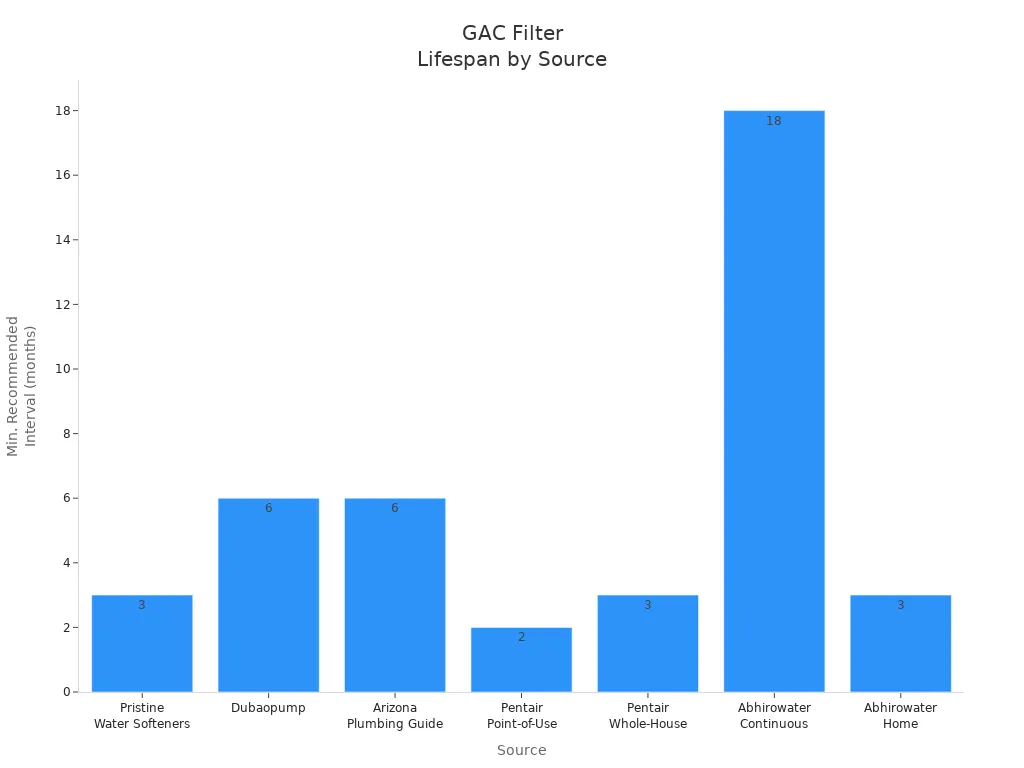
Most filters need to be changed every 6 to 12 months. If your family is big or you use lots of water, change it every 4 to 6 months. Small families using good filters can wait 8 to 10 months. If you do not change the filter, it will stop working. Bad chemicals can get through.
Tip: Write down the date when you put in a new filter. This helps you remember when to check or change it.
Disposal and environmental impact
When you throw away used carbon, think about the environment. Old filters can hold dangerous chemicals like PFAS. You must handle these filters carefully, especially in factories and water plants.
Recycling used carbon is better for the planet than throwing it away.
Special cleaning methods, like thermal reactivation, let you use the carbon again. This saves money and energy.
Putting used filters in landfills or burning them costs more and can hurt nature.
Making new carbon uses lots of energy and chemicals. Recycling helps lower pollution and saves resources.
You can help by picking filters that can be recycled or cleaned for reuse. This cuts down on waste and keeps nature safe.
Selectivity in contaminant removal
Granular activated carbon works for many chemicals, but not all. The size and type of pollutant matter. Some chemicals are too small or do not stick to the carbon. The filter’s design also changes what it can catch. No filter can remove every contaminant. Always check if the filter fits your needs before you buy it.
Maintenance needs
You need to take care of your granular activated carbon filter to keep it working well. If you do not maintain your filter, it will not clean water or air as it should. Good maintenance helps your filter last longer and keeps your home safe.
You should follow these simple steps to keep your GAC filter in top shape:
Check for clogs: Watch for slow water flow. If water moves slowly, your filter might be clogged. You may need to replace the cartridge.
Replace cartridges regularly: Most filters need new cartridges every three to six months. The exact time depends on how much you use the filter and what the manufacturer says.
Sanitize the system: Use a sanitizing solution to clean the filter housing. This step helps stop bacteria from growing inside your filter.
Tip: Write the date on your filter when you install a new cartridge. This helps you remember when to check or change it.
You should also look for signs that your filter needs attention. If your water starts to taste or smell bad, your filter may be full. If you see dark spots or slime, bacteria might be growing. Clean or replace the filter right away.
Here is a simple table to help you remember what to do:
Task | How Often | Why It Matters |
|---|---|---|
Check for clogs | Every month | Keeps water flowing well |
Replace cartridge | 3-6 months | Makes sure filter removes pollutants |
Sanitize system | Every replacement | Stops bacteria from growing |
You should always read the instructions that come with your filter. Some filters may need special care. If you use your filter a lot, you may need to change it more often.
Note: If you have a big family or use lots of water, check your filter more often.
You can keep your water and air clean by following these steps. Regular maintenance protects your health and helps your filter work its best. If you are not sure how to care for your filter, ask an expert for help.
Choosing a granular activated carbon filter
Picking the right granular activated carbon filter is important. It helps you clean your water or air better. You need to think about a few things before you buy one.
Key selection criteria
Particle size and surface area
Check how big the carbon granules are. Smaller granules give more surface area. This helps the filter catch more pollutants. If all the granules are the same size, the flow stays steady. The filter can last longer this way. Filters with lots of tiny holes work best. More surface area means the filter can trap more chemicals.
Source material
The material used to make the carbon matters a lot. Coconut shell carbon is very hard and has lots of surface area. It is great for cleaning water. Coal-based carbon can remove many different pollutants. Wood-based carbon is good for special jobs, like taking color out of liquids. You should also look at the ash content. Less ash (under 5%) means the filter works better and gives cleaner water or air.
Application needs
Think about what you want the filter to do. If you need to remove certain chemicals, check if the filter is made for that. The speed of the water or air matters too. If it moves fast, you might need a bigger filter or more carbon. Make sure the filter meets safety rules like AWWA or ISO. Look for certifications to know the filter is safe for your home or business.
Tip: Always pick a filter that fits your system and removes the right contaminants.
Comparing filter types
There are different kinds of filters you can pick. Each type is good for different things. The table below shows how they are different:
Filter Type | Efficiency | Lifespan |
|---|---|---|
Granular Activated Carbon | High capacity, removes up to 99.9% of VOCs under good conditions. | A few months to several years, based on use. |
Carbon Rod Filters | Compact, improves taste, removes many contaminants. | Fixed intervals set by the maker. |
Granular activated carbon filters work in many places. You see them in city water plants and at home. How well they work depends on how long the water or air touches the carbon. It also depends on how fast it moves. Filters last longer if you use clean water and change them when needed.
Expert consultation
If you do not know which filter to get, ask an expert. Water or air experts can test your water or air. They help you pick the best granular activated carbon filter for your needs. They can also help you set up your filter and tell you how to take care of it.
Note: Getting help from an expert can save you money. It also makes sure your filter works the right way.
When you pick the right filter, you get cleaner water or air. This keeps your family or business safe.
Maintenance and lifespan
Signs of saturation
You should look for signs that your filter is full. When granular activated carbon gets full, it cannot catch more bad stuff. Your water might taste or smell strange. You could see lower water pressure. Sometimes, the water looks cloudy or has odd colors. These things show your filter is not working right. If you use the filter for air, you may notice bad smells again or the air feels less fresh. Always check your filter if you see these problems.
Replacement intervals
Changing your filter on time keeps water and air clean. The best time to change your filter depends on a few things. Water quality, how much you use it, and what the maker says all matter. Check your filter more often if you use lots of water or if your water has many pollutants.
Here is a table to help you know when to change different filters:
Filter Type | |
|---|---|
Smaller Cartridges | Every 3 to 6 months |
Pitcher/Countertop/Faucet | 2 to 6 months or up to 600 gallons |
Under-sink/RO Carbon Stages | 6 to 12 months |
Whole-house Carbon Filters | 3 to 12 months |
Water quality
How often you use it
What the maker recommends
Tip: Write the date on your filter when you put it in. This helps you remember when to check or change it.
Cleaning and regeneration
Some granular activated carbon can be cleaned and used again. Cleaning helps save money and is good for the planet. The best way is called thermal regeneration. This method heats the carbon to about 1000º F. Most trapped chemicals turn into gases and leave the carbon. After heating, steam washes away leftover pollutants. The carbon is almost as good as new and can be used again.
Some scientists use heat and acid to clean the carbon. For example, phosphoric acid (H3PO4) removes ash from the surface. This makes the carbon work better and gives it more surface area. Another study found that heating used carbon at 600 °C for two hours in a CO2 atmosphere helps it trap pollutants again. The cleaned carbon can work almost as well as new carbon.
Note: Cleaning and reusing your filter helps you use it longer. Always follow safety rules and what the maker says when you try these methods.
Best practices
You want your granular activated carbon (GAC) filter to last long and work well. There are easy steps you can follow to help your filter do its job. These steps keep your water or air clean and help you save money.
Perform regular maintenance
Check your filter often. Clean or change parts when needed. This stops big problems and keeps your system working.Monitor for breakthrough
Test your water or air on a schedule. Watch for signs that bad stuff is getting through. If you find a problem early, you can fix it fast.Inspect pressure gauges
Look at the pressure in your system. If it goes up or down quickly, there may be a clog or leak. Fix these problems right away.Backwash when needed
Some filters need backwashing. This means cleaning the carbon bed and washing out dirt. Follow the maker’s advice for how often to do this.Check seals and housings
Make sure seals fit tight. Look for cracks or leaks in the housing. Good seals stop water or air from skipping the filter.Verify flow control devices
Flow control keeps water or air moving at the right speed. If it is too fast or slow, the filter will not work as well. Test these devices often.Keep good records
Write down when you do maintenance or change parts. Track how long your system works and any problems. Good notes help you see patterns and plan ahead.Use pre-treatment
Take out solids and iron before water goes into the GAC filter. This stops clogs and helps the carbon last longer.Maintain steady flow rates
Keep the flow rate even. If it changes fast, water or air may only go through part of the carbon. This makes the filter work less well.Avoid chlorination spikes
Do not let chlorine levels jump unless you plan to clean the carbon. Too much chlorine can hurt the filter.Control pH levels
Keep pH in the best range for the chemicals you want to remove. The right pH helps the carbon work better.Prevent bed compaction
Use hydraulic control to stop the carbon bed from packing down. If it packs down, water or air cannot move well.Support biological activity (for BAC systems)
If you use biological activated carbon, keep enough oxygen in the water. This helps good bacteria grow and break down bad stuff.
Here is a table to help you remember these best practices:
Task | Why It Matters |
|---|---|
Regular maintenance | Makes filter last longer, saves money |
Scheduled sampling | Finds problems early |
Pressure gauge checks | Spots clogs or leaks |
Backwashing | Cleans carbon, stops clogs |
Seal and housing inspection | Stops leaks and bypass |
Flow control verification | Keeps filter working well |
Record keeping | Tracks system health and fixes |
Pre-treatment | Protects carbon from solids and iron |
Steady flow rates | Stops channeling, helps filter work better |
pH control | Helps remove chemicals |
Hydraulic control | Stops compaction, keeps flow steady |
Oxygen for BAC systems | Helps good bacteria grow |
Tip: Always follow the maker’s instructions for your filter. Each system may need special care.
If you follow these best practices, your granular activated carbon filter will last longer and work better. You get cleaner water or air and save money on repairs.
Granular activated carbon is good for cleaning water and air. It takes out many organic compounds and makes water taste better. It also lowers chlorine in water. You can use it at home or in factories. But it cannot remove every contaminant. Sometimes you need to change the filter often. Look at the table below for a quick summary:
Benefits | Limitations |
|---|---|
Don’t remove all contaminants | |
Improve taste and odor | May need frequent replacement |
Reduce chlorine levels | Can’t remove dissolved minerals or salts |
Use in home and industrial settings | Might allow bacterial growth if not maintained |
Pick a filter that fits what you need. Make sure to take care of it. If you are not sure, ask a water or air expert for help. You can also read trusted guides about filtration and water safety.