
You use Industrial waste gas treatment Activated Carbon to capture harmful pollutants from the air. When you implement this method, gas passes through a bed filled with activated carbon. The adsorption process effectively retains volatile organic compounds and other pollutants, resulting in cleaner air. Many industries choose industrial waste gas treatment Activated Carbon because it operates quickly and efficiently, even with varying gas flows. This approach helps you achieve treatment objectives and comply with stringent environmental regulations while minimizing waste.
Key Takeaways
Activated carbon takes in harmful pollutants from waste gases. This helps make the air cleaner.
Activated carbon has a large surface area. This helps it catch many pollutants. It is a strong tool for cleaning air.
Picking the right activated carbon is important. Coal-based or biomass-based types work better for different needs.
Activated carbon needs regular care and cleaning. This helps it keep working well and follow rules for the environment.
Changing things like temperature, humidity, and flow rate can help activated carbon work better in waste gas treatment.
Activated carbon can be used in many ways. It works in power plants, light recycling, and cleaning wastewater.
Using activated carbon helps companies follow strict environmental laws. This protects people’s health and the environment.
Knowing how adsorption works can help use activated carbon better. This removes more pollutants.
Activated Carbon Properties
Structure and Porosity
Activated carbon has a special structure. It is full of tiny pores. These pores give it a very large surface area. This helps it catch pollutants from industrial waste gases.
High Surface Area: One gram of activated carbon can have a surface area as big as 500 to 2000 square meters. This means there are lots of places for pollutants to stick.
Pore Size Distribution: There are three main types of pores. They are micropores, mesopores, and macropores. Each type catches different sizes of molecules. This makes activated carbon good for many gases.
Surface Chemistry: The surface has groups that contain oxygen. These groups help activated carbon grab and hold chemicals. This works best for chemicals with certain polarities.
Tip: If you pick activated carbon with the right pore size and surface chemistry, your waste gas treatment will work better.
Types of Activated Carbon
There are different types of activated carbon for industrial waste gas treatment. The two most common types are coal-based and biomass-based activated carbon. Each type is good for different things.
Type of Activated Carbon | Advantages | Applications |
|---|---|---|
Coal-based | High adsorption capacity, stability in acidic and basic conditions | Industrial waste gas treatment, chemical treatment, air filtration |
Biomass-based | Environmental sustainability, economic efficiency, renewable resources | Industrial waste gas treatment, environmental remediation |
Coal-based activated carbon is strong at catching pollutants. It works well even in tough conditions.
Biomass-based activated carbon is better for the environment. It works well and uses renewable materials.
Effectiveness in Treatment
Activated carbon works well for industrial waste gas treatment if you pick the right kind. Its large surface area gives more places for pollutants to stick. The different pore sizes help catch both small and big molecules. The surface chemistry helps catch certain chemicals, like volatile organic compounds and odors.
Choosing the right type of activated carbon helps you meet your needs. Coal-based activated carbon is good for hard jobs and strong chemicals. Biomass-based activated carbon is better if you want a green and cheap option.
Using activated carbon helps you follow strict environmental rules. It also makes the air cleaner. This material removes harmful gases before they get outside. It helps keep your workplace clean and protects people’s health.
Industrial Waste Gas Treatment Activated Carbon Process
Gas Collection
First, you collect the gas from your factory. This step is important because it gathers all the harmful stuff before it gets outside. There are different ways to collect the gas:
Cyclonic Processes: These spin the gas fast to pull out tiny bits. You use this when the gas is very hot or under a lot of pressure.
Electrostatic Precipitation (ESP): This method gives the particles an electric charge. The charged particles stick to plates. There are single-stage and two-stage ESPs. Two-stage ESPs are better for catching small bits.
A suction hood pulls the gas from where it starts. This hood stops the waste from spreading. You make sure the collection system fits your factory. Good collection helps you follow the rules and keeps people safe.
Tip: Always look for leaks in your collection system. Even small leaks can let bad gas out.
Gas Transport
After you collect the gas, you need to move it. Pipes and fans help carry the gas to the next part. The pipes take the gas from the start to the treatment area. An exhaust fan pushes the gas through the pipes. The gas must move at the right speed. If it goes too fast, it can break things. If it goes too slow, it might not get there in time.
The gas usually goes through a dry filter first. This filter takes out dust and big pieces. Clean gas helps the next steps work better. You need to check the pipes and fans often. If something blocks or breaks, waste can escape.
Adsorption by Activated Carbon
Now you reach the main part of the process. The gas goes into a machine filled with activated carbon. Here, adsorption happens. The gas moves over the surface of the activated carbon. The pollutants stick to the carbon. This is called the adsorption process.
The activated carbon has a big surface and many tiny holes. These help catch lots of pollutants. Adsorption works well for gases like carbon dioxide and methane. For example, some activated carbon made from old tires can hold 1.42 mmol of carbon dioxide per gram. Other types, like those from microcrystalline cellulose, can hold even more—up to 2.15 mmol per gram at room temperature.
Source | Gas Type | Adsorption Capacity (mmol/g) | Notes |
|---|---|---|---|
Spent tire-based activated carbon | CO2 | 1.42 | Good for recycling waste materials |
Microcrystalline cellulose-based activated carbon | CO2 | 2.15 | High capacity at 25°C and 101.3 kPa |
General activated carbon | CH4 | N/A | High selectivity for methane |
You need to pick the right activated carbon for your gas. The adsorption process takes out harmful chemicals and smells. This helps you follow strict rules. It also keeps workers and the community safe.
Note: The adsorption process does not destroy the pollutants. It just traps them on the activated carbon. You have to change or clean the carbon when it is full.
Purification
This is the last step in the industrial waste gas treatment activated carbon process. Purification makes sure the air leaving your system is safe and clean. After the gas goes through the activated carbon, it might still have tiny bits of pollutants. You need to get rid of these last bits to follow strict environmental rules.
You can use different ways to purify the gas. Each way targets certain pollutants and helps you remove them well.
Wet scrubbers use a liquid to wash the gas. The liquid grabs and takes away harmful chemicals.
Biological methods use special bacteria. These bacteria break down pollutants into harmless things.
Catalytic oxidation uses a catalyst and heat. This changes dangerous chemicals into safer ones.
Hybrid systems mix two or more methods. These systems work better for tough pollutants.
You must pick the right purification technology for your factory. The design and how you run these systems help you follow important standards like ISO14001 and EPA rules. Using these methods protects the environment and keeps your community safe.
Tip: Always check your purification system often. Regular checks help you find problems early and keep your system working well.
Purification is not just about cleaning the gas. It is also about following the law and showing you care about the air people breathe. You make a big difference when you use the right purification steps in your process.
Adsorption Principles
To treat waste gas well, you must know how adsorption works. Activated carbon traps pollutants in two ways: physical adsorption and chemical adsorption. Each way uses different forces to catch bad molecules.
Physical Adsorption
Physical adsorption uses weak forces to hold pollutants. You do not need high heat or special chemicals. This process happens fast and can be undone.
Surface Area Role
The surface area of activated carbon is very important. If the surface area is big, more pollutants can stick. This makes waste gas treatment work better.
One gram of activated carbon can have over 500 m² of surface area.
Surface areas of 3,000 m² are common.
Some activated carbon has a BET area of 4,800 m²/g, which is the highest found.
More surface area means more adsorption. You should pick activated carbon with the biggest surface area.
Van der Waals Forces
Van der Waals forces help physical adsorption work. These forces make a weak pull between activated carbon and gas molecules. You do not need strong bonds. The process takes in heat.
Characteristics | Process Type | |
|---|---|---|
Physical Adsorption | Caused by van der Waals forces; involves electrostatic attraction; endothermic. | Endothermic |
Chemical Adsorption | Involves chemical bond formation; exothermic; involves destruction and recombination of bonds. | Exothermic |
Physical adsorption is fast and can be reversed. This lets you clean and reuse the activated carbon.
Chemical Adsorption
Chemical adsorption uses strong forces to trap pollutants. Activated carbon makes chemical bonds with gas molecules. This process is slower but lasts longer.
Bond Formation
Chemical adsorption forms new bonds with pollutants. These bonds can be covalent or ionic. The process is stronger and stays longer.
Covalent bonds form in chemisorption.
Ionic bonds can also happen in chemisorption.
Weak van der Waals forces are part of physisorption.
Chemisorption uses strong chemical bonds, like covalent and ionic.
Physisorption uses weaker forces, like van der Waals.
Chemical adsorption gives off heat when bonds form. This makes the process stable and hard to undo.
Selectivity
Chemical adsorption is picky. You can catch certain pollutants by picking the right activated carbon. The surface chemistry and pore shape help grab some molecules better.
Factor | Description |
|---|---|
Bed Depth | Deeper beds help stop leaks and make sure the top layer is full. |
Exchange Velocity | The right speed is important; too much can cause problems if pollution is high. |
Organic Matrix | It fights with pollutants for spots, which changes how much activated carbon can hold. |
You can make adsorption better by changing bed depth and speed. You must also think about the organic matrix, which fights for spots. This helps you get the best results for waste gas treatment.
Tip: Always check your adsorption bed. Changing depth and speed can make it work better and help you follow rules.
Now you know how adsorption works. Use physical adsorption for quick and easy treatment. Use chemical adsorption for strong and picky pollutant capture. Knowing these ideas helps you build a better waste gas treatment system.
Factors Affecting Activated Carbon Waste Gas Treatment
Compound Types
You need to know which compounds activated carbon removes best. Some chemicals stick to activated carbon more easily. This depends on their size, shape, and how they touch the carbon. For example, xylene, ethylbenzene, and toluene are removed very well. Other chemicals, like chloroform, are harder to catch.
Here is a table that shows how well activated carbon removes some common compounds:
Compound Type | Removal Efficiency Order |
|---|---|
Xylene | 1 |
Ethylbenzene | 2 |
Toluene | 3 |
Tri or Tetrachloroethylene | 4 |
Benzene | 5 |
Carbon Tetrachloride | 6 |
Chloroform | 7 |
You can also see this in the chart below:
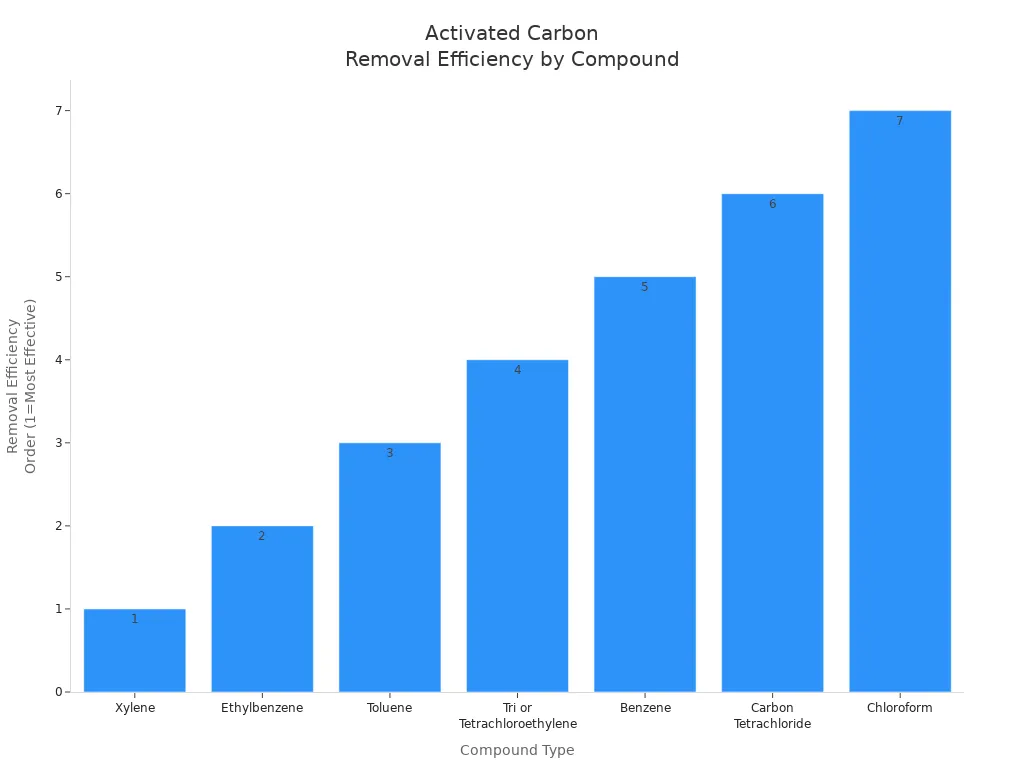
If your waste gas has a lot of xylene or toluene, you will get good results. For chemicals lower on the list, you might need to change your process or use more activated carbon.
Tip: Always check what chemicals are in your waste gas before you pick a treatment method.
Surface Area and Pore Size
The surface area and pore size of activated carbon are important. A large surface area gives more places for pollutants to stick. The size of the pores decides which molecules can fit inside and get trapped.
More surface area means more spots to catch pollution.
Bigger surfaces can remove more pollution from air or water.
Pore size decides what kind and size of molecules can be caught.
Different jobs need different pore sizes, depending on the pollution.
If your waste gas has big molecules, you need bigger pores. For small molecules, smaller pores work better. Always match the pore size and surface area to the pollution you want to remove.
Temperature and Humidity
Temperature and humidity can change how well activated carbon works. High humidity means water vapor fights with pollution for spots on the carbon. This makes the carbon hold less pollution. When the air is very wet, the carbon can only hold about half as much as in dry air.
Temperature also matters. At room temperature, activated carbon works best for volatile organic compounds. If the temperature goes up, the molecules move faster and do not stick as well. This means the carbon cannot hold as much pollution.
Here is a table that shows how different conditions change how much pollution activated carbon can hold:
Condition | Effect on Adsorption Capacity |
|---|---|
High Humidity | Water fights with VOCs for spots, so capacity goes down |
Relative Humidity | At 80%, capacity may drop to half compared to dry air |
Increased Temperature | Higher heat means less pollution sticks to the carbon |
Room Temperature | Best for catching VOCs |
High Temperature | Much less pollution can be caught |
Note: You should control temperature and humidity in your system to help your activated carbon work its best.
Flow Rate
Flow rate tells you how fast waste gas moves through your treatment system. You must pay attention to flow rate because it changes how well activated carbon works. If gas moves too quickly, pollutants may not stick to the carbon. If gas moves too slowly, your system may not treat enough gas in time.
You can measure flow rate in cubic meters per hour (m³/h) or cubic feet per minute (CFM). Most systems use fans or blowers to control flow rate. You need to set the right speed for your system.
Why does flow rate matter?
High flow rate means gas passes through the carbon bed fast. Pollutants may not have enough time to stick to the carbon. You lose efficiency.
Low flow rate means gas stays in the carbon bed longer. Pollutants have more time to stick. You get better removal, but you may treat less gas.
The best flow rate balances speed and efficiency. You want to treat enough gas and remove as many pollutants as possible.
Flow Rate | Effect on Adsorption | Efficiency |
|---|---|---|
Too High | Pollutants pass through | Low |
Too Low | Slow treatment, high removal | Medium |
Optimal | Good removal, fast treatment | High |
You must check your system often. If you see a drop in removal efficiency, you may need to adjust the flow rate. You can use sensors to monitor flow rate and set alarms if it goes outside the target range.
Tip: Always match flow rate to the size of your carbon bed. Bigger beds can handle higher flow rates. Smaller beds need slower flow rates.
You can also change flow rate based on the type of pollutants. Sticky pollutants need slower flow rates. Light pollutants may need faster flow rates to keep the system moving.
Some systems use variable speed fans. These fans let you change flow rate during operation. You can increase flow rate when pollution levels are low. You can slow it down when pollution levels are high.
You must also think about pressure. High flow rate can cause high pressure in the pipes. This may damage your system. Always check pressure gauges and keep flow rate within safe limits.
If you want your activated carbon system to work well, you must control flow rate. You get better pollutant removal, save energy, and protect your equipment. Flow rate is one of the most important factors in waste gas treatment.
Real-World Applications
Coal-Fired Power Plants
Activated carbon is used in coal-fired power plants to control mercury. Workers put activated carbon into the flue gas stream. The carbon grabs mercury and other pollutants. This method is called Activated Carbon Injection, or ACI. By 2008, more than 90 ACI systems worked in the USA. Many countries use ACI because it removes mercury well.
Activated carbon with halogens can change mercury in the gas. It makes compounds like HgBr2. These compounds react with special groups to make HgO. This helps remove more mercury from the gas. Using activated carbon helps power plants follow rules and keeps people safe.
Aspect | Details |
|---|---|
Purpose | Mercury control in coal-fired power plants |
Method | Activated carbon injection into flue gas stream |
Effectiveness | Significant reduction of mercury emissions |
Implementation | Over 90 ACI systems in the USA by 2008 |
Challenges | Need for ongoing development and cost control |
Tip: You should check the halogen level in activated carbon to catch more mercury.
Fluorescent Light Recycling
Activated carbon is used when recycling fluorescent lights. When you break or handle these lamps, mercury vapor comes out. Activated carbon filters catch this vapor. These filters must go to special waste places for safe treatment.
Good recycling steps help keep mercury from escaping. Activated carbon filters make sure mercury does not get into the air. This keeps workers and the environment safe.
Activated carbon catches mercury vapor during lamp recycling.
Filters are sent to hazardous waste places for safe handling.
You must use the right recycling tools to stay safe.
Note: Always follow recycling rules to stop mercury from getting into the air.
Natural Gas Processing
Activated carbon is used in natural gas processing to clean gas. It grabs pollutants using physical and chemical ways. Activated carbon removes heavy metals like mercury, lead, and cadmium from the gas. It also catches dioxins, which are very harmful.
Activated carbon lowers the amount of sulfur oxides and nitrogen oxides in the gas. This makes the air cleaner and helps companies follow the rules.
Activated carbon grabs heavy metals from gas.
It catches dioxins and other harmful things.
You can lower sulfur oxides and nitrogen oxides with activated carbon.
Tip: Check your activated carbon system often to keep it working well.
Mercury Removal
You can use activated carbon to take mercury out of waste gas. Mercury is very harmful to people and nature. Activated carbon traps mercury so it does not get into the air. There are a few ways to remove mercury.
Fixed-bed adsorption uses activated carbon with sulfur. This way can take out 90% to 95% of mercury. You put the activated carbon in one place and let gas move through it. The sulfur in the carbon grabs the mercury and holds it tight.
Cooling natural gas makes mercury turn into a liquid. You cool the gas until mercury becomes liquid. This method also removes over 90% of mercury. You can do this before the gas goes to the activated carbon bed.
Activated carbon in flue gas treatment catches different types of mercury. If you add sulfur to the carbon, it works even better. This helps the carbon catch more mercury and increases how much it removes.
You need to check your system often to make sure it works well. Using activated carbon with sulfur gives you better results. You help your factory follow the rules and keep the air clean. You also keep workers and people in the area safe.
Tip: Always watch how much mercury you remove. If the number drops, you may need to change or clean your activated carbon.
Wastewater Treatment
You use activated carbon to clean dirty water from factories. This material takes out bad chemicals and heavy metals. The process is called adsorption. Activated carbon has a big surface, so it can trap many pollutants. You help your factory follow the rules and keep rivers and lakes safe.
Many factories use activated carbon to treat their wastewater:
Chemical plants
Pharmaceutical companies
Food processing places
Mining sites
Electroplating factories
Battery making sites
You lower the chemical oxygen demand (COD) and biological oxygen demand (BOD) in the water. This is important because high COD and BOD can hurt fish and other water animals. When you let out clean water, you help keep nature healthy.
You must check your activated carbon often. If it gets full, you need to change or clean it. You also need to test the water to make sure it is safe.
Note: Activated carbon helps you take out many kinds of pollution. You help keep water clean and safe for everyone.
Industry Type | Activated Carbon Use |
|---|---|
Chemical Plants | Takes out organic chemicals and metals |
Food Processing | Cleans water before letting it out |
Mining | Traps heavy metals |
Electroplating | Removes toxic things |
Battery Manufacturing | Catches harmful chemicals |
You can trust activated carbon to help your factory stay within the law. You protect nature and help keep people healthy.
Benefits and Limitations of Treatment
Advantages
You get many good things when you use industrial waste gas treatment activated carbon. The material has lots of tiny holes. These holes give it a big surface area. This helps it catch pollutants from the air fast and well. Activated carbon can take out volatile organic compounds and bad smells. Some types can even change certain chemicals, like formaldehyde, into safer things. You can meet strict air rules and sometimes do even better. This technology is great for removing VOCs from factory air. Activated carbon does not break down in acid, alkali, heat, or water. It is also easy to use again after cleaning. That is why many factories pick it for cleaning waste gases. You can trap harmful air pollution from many places. The process is simple and works well for cleaning factory air.
Big surface area helps catch more pollution
Works well for VOCs and bad smells
Can change some chemicals into safer ones
Meets tough air quality rules
Stays strong in acid, alkali, and heat
Easy to clean and use again
Simple and reliable to run
Tip: Using activated carbon waste gas treatment makes air cleaner and keeps people healthy.
Challenges
There are some problems when you use activated carbon for cleaning gas. The carbon can fill up with pollution, so it cannot catch more. You have to check the system so pollution does not get out. Some chemicals fight for space on the carbon, which makes it work less well. High heat and wet air can also make it not work as well. You need to pick the right kind of activated carbon for your waste gas. Taking care of the system and cleaning the carbon takes time and planning. If you do not do these things, the system may not work well and can cost more money.
Maintenance and Regeneration
You need to take care of and clean activated carbon to keep it working. The carbon grabs pollution, but it holds onto it over time. You can clean it in different ways to make it work again. Heating the carbon to high temperatures gets rid of pollution. You can also use water vapor, hot air, vacuum, chemicals, living things, electricity, or sound waves.
Regeneration Method | Description |
|---|---|
Thermal Regeneration | Heat the carbon to remove pollution, often with water vapor or hot air. |
Vacuum Regeneration | Use pressure changes to help clean the carbon. |
Chemical Regeneration | Use chemicals to wash out pollution from the carbon. |
Biological Regeneration | Use living things to break down pollution on the carbon. |
Electrochemical Processes | Use electricity to help clean the carbon. |
Ultrasonic Regeneration | Use sound waves to help remove pollution from the carbon. |
You can look at how well and how hot each cleaning method is. Some ways, like using microwaves, work very well at medium heat. Other ways, like using nitrogen or water vapor, do not work as well and need careful control.
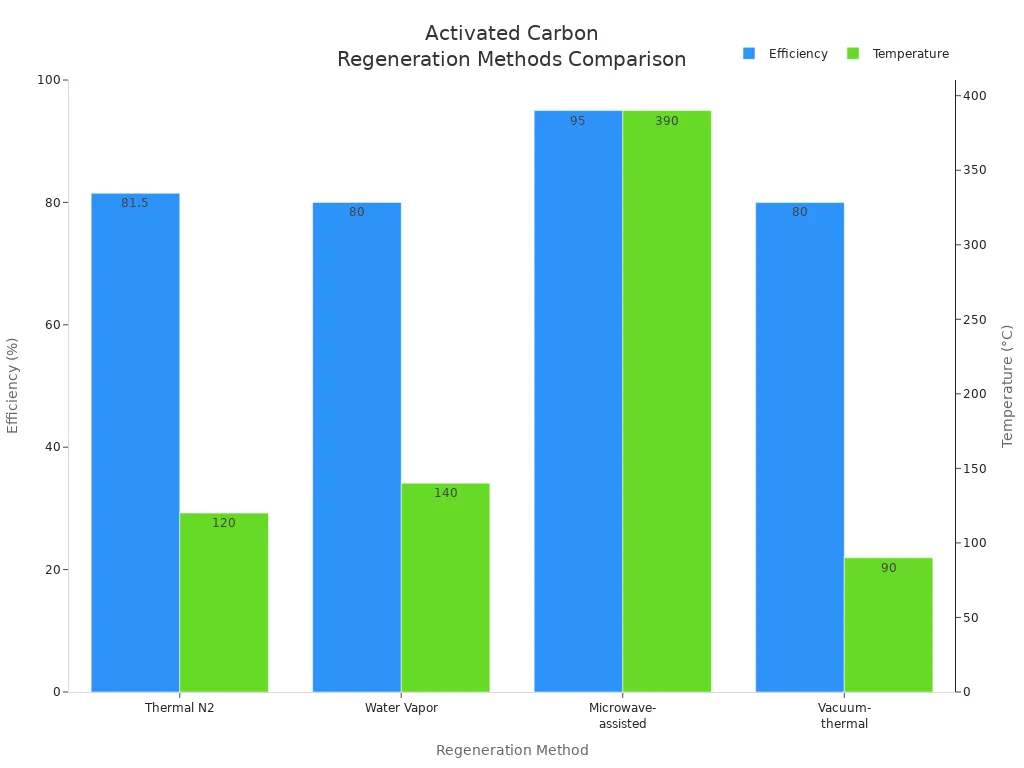
Regeneration Method | Temperature (°C) | Notes | |
|---|---|---|---|
Thermal N2 | 81.5 | 120 | Leftover pollution can block holes and lower how well it works. |
Water Vapor | <80 | 140 | Water fights with pollution for space, so cleaning is not as good. |
Microwave-assisted | 95 | 390 | Works very well if you control the power. |
Vacuum-thermal | 80 | 90 | Better than old heating ways and does not hurt the holes as much. |
Note: Pick the cleaning method that works best for your system and waste gas. Check and clean your system often to keep it working well and follow the rules.
You use activated carbon to clean waste gas by catching bad chemicals. This way works well and helps you follow air rules. But there are some problems, like high cost and using a lot of energy. These problems make people look for better choices.
Limitation of Activated Carbon | Impact on Adoption of Alternatives |
|---|---|
High cost | Drives search for economical adsorbents |
Energy-intensive production | Encourages exploration of sustainable materials |
Declining effectiveness | Necessitates finding more efficient alternatives |
In the future, new ways will make activated carbon better. Scientists use heat, chemicals, plasma, and even living things to help it work longer and be safer for the earth.