
You can trust impregnated activated carbon for strong filtration. This material has extra chemicals that help it trap and stop harmful things. The table below explains how it works:
Mechanism | Description |
|---|---|
Physical Adsorption | Uses physical forces to pull in and hold pollutants. |
Chemical Action | Uses chemical reactions to remove pollutants better. |
Targeted Contaminant Removal | Made to remove pollutants like mercury and hydrogen sulfide more easily. |
Enhanced Adsorption and Chemisorption | Mixes physical adsorption with chemisorption for stronger bonds with contaminants. |
Chemical Reactions | Helps reactions that change or break down pollutants into safer things. |
In 2026, more people will want this technology.
The global market size may reach $441 million by 2032.
The market will grow 1.8% each year from 2026 to 2032.
Key Takeaways
Impregnated activated carbon cleans better by using special chemicals. These chemicals help trap dangerous pollutants very well.
This material is made to remove certain contaminants. It works best for things like mercury and hydrogen sulfide.
Impregnated activated carbon has a special structure. It has a big surface area and many tiny holes. This helps clean air and water quickly and well.
Different chemicals make the carbon better at removing different pollutants. You should pick the right type for what you need.
Using impregnated activated carbon can save money over time. It works for a long time and costs less to use than other filters.
This technology can be used in many ways. It helps clean air, treat water, and fix pollution, so it is useful in many jobs.
One big benefit is that it is good for the planet. It uses materials that can be replaced and cleaner ways to make it, which helps the environment.
More people want better filters now. So, there will be new ideas for impregnated activated carbon to help with new problems.
Impregnated Activated Carbon Overview
Definition and Structure
Impregnated activated carbon is a special kind of filter. It starts as activated carbon with lots of tiny holes. These holes give it a big surface area. Manufacturers add chemicals called impregnates to the carbon. The chemicals go on the surface and inside the holes. These chemicals help the carbon catch certain pollutants. This makes it work better for some gases, vapors, and liquids.
Key Features
Porosity and Surface Area
Impregnated activated carbon has a very large surface area. The many pores give more places for pollutants to stick. This means it can hold more harmful things in less space. The high porosity lets air or water move through fast. This helps clean things quickly and well.
Distribution of Impregnates
Manufacturers spread the impregnates all over the carbon. This even spread lets every part react with pollutants. The chemicals reach all the small spaces where contaminants hide. This gives better performance.
Tip: The kind of impregnate changes how well the carbon works. Potassium hydroxide helps trap acidic gases. Iron salts help remove metals like arsenic.
Here is a table that lists the main features that make impregnated activated carbon different from other filters:
Feature | Description |
|---|---|
Specificity | Made to catch certain gases and vapors using added chemicals. |
Adsorption Capacity | Uses both physical and chemical ways to remove more pollutants. |
Chemical Interactions | The chemicals inside react with target contaminants, removing things that regular carbon cannot. |
Catalytic Conversion | Changes dangerous pollutants into safer ones through chemical reactions. |
Dual Functionality | Works as both an absorbent and a chemical reactor for better removal of hazardous substances. |
Comparison to Standard Activated Carbon
Impregnated activated carbon works better than regular activated carbon. Regular activated carbon mostly uses physical adsorption. It can trap many pollutants but not all chemicals. Impregnated activated carbon has extra chemicals for more power. These chemicals help break down pollutants that regular carbon cannot remove.
Here is a table that shows how much better impregnated activated carbon can work:
Type of Activated Carbon | COD Removal Efficiency (%) | |
|---|---|---|
Maize Tassel Activated Carbon (MTAC) | 484 | 96.8 |
Commercial Activated Carbon (CAC) | 370 | 85 |
You can see that impregnated types remove more contaminants and work better.
There are many kinds of impregnates, and each helps with a different problem:
Coconut shell carbon lowers fine dust and works for small particles.
Potassium hydroxide (KOH) traps acidic gases like sulfur dioxide.
R-aminated compounds help with acidic and aldehydic pollutants.
Potassium permanganate breaks down strong smells and reactive chemicals.
Iron salts help remove arsenic up to ten times better and help with organic matter.
Aluminum-impregnated carbon removes fluoride much better than regular carbon.
Silver and nickel impregnates help remove cyanide.
You can pick the right impregnated carbon for the pollutant you want to remove. This makes impregnated activated carbon a smart choice for targeted cleaning in 2026.
How Impregnated Activated Carbon Works
Adsorption Mechanism
Impregnated activated carbon cleans air and water in two ways. It uses physical adsorption and chemical adsorption. Adsorption means the carbon grabs and holds harmful things.
Physical Adsorption
Physical adsorption happens when pollutants stick to the carbon’s surface. The carbon has lots of tiny holes and a big surface area. This gives more room for pollutants to attach. The pollutants do not change. They just stay on the surface. Non-impregnated activated carbon mostly uses this way. It can trap heavy metals like cadmium, copper, and lead. The carbon holds these metals with forces like partitioning and pore diffusion. Surface groups like carbonyl and carboxyl help the carbon grab these metals.
Chemical Adsorption
Chemical adsorption is different from physical adsorption. Here, chemicals added to the carbon react with pollutants. This reaction forms a strong bond. Pollutants do not just stick to the surface. They change into something safer or get trapped inside the carbon. Using impregnated activated carbon works better for some gases and chemicals. For example, to remove carbon dioxide, adding metals like chromium or iron helps. This can increase adsorption by about 20%. Chemical adsorption makes the process stronger and more effective.
Chemical Reactions
Impregnated activated carbon does more than just hold pollutants. It can also change them using chemical reactions. When a pollutant touches the carbon, the chemicals inside react with it. This reaction can destroy the harmful substance or turn it into something safe. For example, sulfur in the carbon can react with mercury to make a safe compound. Silver can kill bacteria in water. Copper helps remove chlorine. These reactions make the carbon very useful for cleaning dangerous chemicals.
Here is how the process works:
Pollutants touch the impregnated activated carbon.
The chemicals inside the carbon react with the pollutants.
The reaction changes the pollutants into safer forms or traps them.
Note: These chemical reactions help remove things that regular carbon cannot handle.
Targeted Purification
Impregnated activated carbon can target certain contaminants. The chemicals added to the carbon make it selective. You can pick the right type of carbon for the pollutant you want to remove. For example, to get rid of mercury, use carbon with sulfur. To kill bacteria, use carbon with silver. In wastewater treatment, carbon with ionic liquids can remove antibiotic resistance genes and bacteria. This selectivity makes impregnated activated carbon helpful in many industries.
Tip: Always match the type of impregnated activated carbon to the contaminant you need to remove for the best results.
Now you know that adsorption and chemical reactions work together in impregnated activated carbon. This gives you a strong and flexible way to clean air, water, and industrial gases.
Types of Impregnated Activated Carbon
Acid-Impregnated Carbon
Acid-impregnated activated carbon is good for removing alkaline gases and some pollutants. Manufacturers add acids or acid salts to the carbon. This changes the carbon’s surface and helps it work better for certain jobs. You can use acid-impregnated carbon to remove ammonia, VOCs, and gases from factories.
Here is a table that lists common acid agents and what they do:
Impregnating Agent | Application |
|---|---|
Sulfur | Mercury removal in wastewater and air purification |
Silver | Sterilization for drinking water treatment |
KI | H₂S, VOC, and siloxane removal |
KOH | H₂S removal in biogas treatment |
CuO | Water treatment, acid gas, and VOC removal |
K₂CO₃ | NH₃ and acid gas removal |
H₃PO₄ | NH₃ removal |
HNO₃ | VOC, NH₃, and exhaust gas removal |
KMnO₄ | Harmful gas, VOC, odor removal, and gas mask protection |
Acid-impregnated carbon has lots of surface area and holds onto pollutants well. You can use it in home water filters, pollution scrubbers, and gas masks. The way it is made helps it focus on certain pollutants, so it works better for your needs.
Tip: Use acid-impregnated carbon if you need to get rid of ammonia, VOCs, or mercury from air or water.
Base-Impregnated Carbon
Base-impregnated activated carbon is used to remove acidic gases like SO₂ and H₂S. Manufacturers add alkaline chemicals like potassium hydroxide or sodium hydroxide to the carbon. This makes the carbon react more with acidic pollutants.
You can use base-impregnated carbon in biogas plants, factories, and places that need odor control. The alkaline chemicals react with acidic gases and trap them. This makes the air safer to breathe. Base-impregnated carbon is helpful where there are lots of acidic gases.
Here is a short list of base agents and what they do:
Potassium hydroxide (KOH): Removes acidic gases in biogas and air cleaning.
Sodium hydroxide (NaOH): Used for factory exhaust and odor control.
Calcium carbonate (CaCO₃): Helps neutralize acids in water treatment.
Note: Base-impregnated carbon is best for places with lots of acidic gases.
Metal-Impregnated Carbon
Metal-impregnated activated carbon is used for cleaning tough pollutants. Manufacturers add metals like silver, copper, manganese, aluminum, iron, or sulfur to the carbon. Each metal helps remove different pollutants and makes the carbon work better.
Here is a table that shows the metals, their main uses, and what they remove:
Impregnating Agent | Primary Application | Key Pollutants Removed |
|---|---|---|
Silver (Ag) | Drinking water, medical devices | Bacteria, viruses |
Copper (Cu) | Industrial gas, biogas | H₂S, mercaptans |
Manganese (MnO₂) | Groundwater, wastewater | Iron, manganese, H₂S |
Aluminum (Al₂O₃) | Drinking water | Fluoride, arsenic |
Iron (Fe₂O₃) | Groundwater, wastewater | Arsenic, heavy metals |
Sulfur (S) | Flue gas treatment | Mercury vapor |
Metal-impregnated carbon is used in biogas cleaning, VOC control, and cleaning gases in factories. For example, copper-impregnated carbon removes hydrogen sulfide and cyanide. Silver-impregnated carbon kills bacteria and viruses in water. Zinc acetate-impregnated carbon can hold a lot of CO₂ because it has tiny pores.
Callout: Pick metal-impregnated carbon when you need to remove bacteria, heavy metals, or dangerous gases.
When you pick the right type of impregnated activated carbon, you match the agent to the pollutant you want to remove. This helps you get the best results for cleaning air, water, or industrial gases.
Salt-Impregnated Carbon
Salt-impregnated carbons help clean air and water. Manufacturers add salts like potassium iodide, potassium permanganate, or zinc acetate. These salts change how the carbon works. They make it better at catching certain pollutants.
Salt-impregnated carbons target gases like hydrogen sulfide, VOCs, and siloxanes. The salts react with these gases and trap them inside the carbon. This makes your filter system stronger and more dependable.
Here is a table that lists common salts and what they do:
Salt Agent | Main Application | Pollutants Removed |
|---|---|---|
Potassium Iodide | Air purification | Hydrogen sulfide, VOCs |
Potassium Permanganate | Gas mask filters | Harmful gases, odors |
Zinc Acetate | CO₂ capture | Carbon dioxide |
Salt-impregnated carbons are good for removing strong smells and dangerous gases. You can find them in air filters, scrubbers, and safety gear. The salts inside the carbon react fast with pollutants. This gives you quick and effective cleaning.
Tip: Use salt-impregnated carbons for gases that regular activated carbon cannot remove.
Specialized Types
Specialized impregnated carbons solve special problems. Manufacturers make these carbons for certain jobs. You might need to get rid of bacteria, viruses, or radioactive particles. Specialized types use special chemicals or mixes to catch these tough pollutants.
Some examples are:
Silver-impregnated carbons for killing germs in water.
Nickel-impregnated carbons for removing cyanide from wastewater.
Ionic liquid-impregnated carbons for getting rid of antibiotic resistance genes.
Multi-impregnated carbons that mix metals and salts for extra protection.
You can use specialized impregnated carbons in hospitals, labs, and water plants. These carbons help you follow strict safety rules and keep people safe.
Callout: Always pick the right specialized impregnated carbon for your needs. This helps you get the best results and safety.
When you choose the right type, you get better filtration and protect your surroundings. Specialized impregnated carbons give you strong solutions for the hardest pollutants.
Applications and Uses
Air Purification
People use impregnated activated carbon to clean air in many places. It helps keep the air safe in homes, factories, and hospitals. This material removes toxic gases and controls bad smells.
Toxic Gas Removal
Impregnated activated carbon takes out dangerous gases from the air. It can trap hydrogen cyanide, ammonia, and other harmful things. Special chemicals inside the carbon react with these gases and make them safer.
Here is a table that shows how well impregnated activated carbon works for removing toxic gases:
Application | Removal Efficiency | Notes |
|---|---|---|
Hydrogen Cyanide (HCN) | Copper ions help turn HCN into safer compounds | |
Ammonia (NH3) | Significant | Used for removing toxic gases in factories |
Cu–Zn Impregnated Carbons | Comparable | Works as well as ASC Whetlerite carbon |
You can see that impregnated activated carbon handles tough gases. It keeps people safe from breathing dangerous air in many places.
Tip: Always check which impregnated activated carbon you need before using it. Different chemicals work best for different gases.
Odor Control
Impregnated activated carbon helps stop bad smells at home or work. The carbon catches smelly molecules and keeps them from spreading. It works for kitchen smells, pet odors, and factory fumes.
Many air filters use this material to keep air fresh. The carbon holds onto odor molecules so they do not escape. This gives you cleaner air and a nicer place to be.
Callout: If you want to get rid of strong smells, pick impregnated activated carbon with the right chemicals for your problem.
Water Treatment
Impregnated activated carbon is important for cleaning water. People use it to treat drinking water, wastewater, and water from factories. It removes heavy metals and organic pollutants that can be harmful.
Heavy Metal Removal
You need to get rid of heavy metals like lead, arsenic, and mercury in water. Impregnated activated carbon does this job well. Manufacturers add special chemicals to the carbon so it can grab these metals.
Regular activated carbon does not work for heavy metals. You must use improved carbon or other methods. Reverse osmosis and ion exchange can remove lead very well, over 95%. Rajah Filter Technics uses additives with activated carbon to help remove more lead. This shows you need extra help for the best water treatment results.
Note: Always use impregnated activated carbon with the right additives for heavy metal removal. This gives you safer water.
Organic Contaminant Removal
Impregnated activated carbon also removes organic pollutants from water. These include pesticides, solvents, and other chemicals. The carbon traps these molecules and keeps them out of your water.
Water treatment plants use this material to protect people from harmful chemicals. The carbon’s large surface area and special chemicals make it work well. You get cleaner water for drinking and other uses.
Tip: Pick impregnated activated carbon with the right chemicals for the organic pollutants you want to remove.
Environmental Remediation
You help keep the environment safe. Impregnated activated carbon is used to clean up dirty places and fix nature. This material removes hard-to-clean pollution from soil and water. You can use it for oil spills, chemical leaks, and dirty groundwater.
Impregnated activated carbon can remove many kinds of pollution. It is used for organic chemicals like chlorinated solvents and petroleum hydrocarbons. These chemicals come from factories, gas stations, and old work sites. When you use impregnated activated carbon, it grabs these pollutants fast. The special chemicals in the carbon change harmful things into safer ones.
You get fast cleanup with this technology. It stops pollution from coming back after cleaning. This means you get long-lasting results and meet safety rules. You can use impregnated activated carbon right at the polluted spot. You do not need to dig up or move the soil.
Here are some common pollutants that impregnated activated carbon can help with:
Chlorinated solvents (like trichloroethylene, TCE)
Petroleum hydrocarbons (such as gasoline and diesel)
Volatile organic compounds (VOCs)
Heavy metals (like mercury and arsenic)
Pesticides and herbicides
Some products, like BOS 100®, use both adsorption and breakdown. These products clean up pollution faster and break it down better. BOS 100® is very good for TCE. It turns TCE into chloride and other safe things. You get better results than with other ways. This means cleaner soil and water.
Tip: Pick impregnated activated carbon for places with tough organic pollution. It works fast and helps stop pollution from coming back.
You can see the good things about using impregnated activated carbon for cleaning the environment:
Benefit | Description |
|---|---|
Fast Removal | Grabs pollutants quickly and efficiently |
Limited Rebound | Keeps contaminants from returning after treatment |
Targeted Action | Focuses on specific chemicals and metals |
In Situ Application | Treats pollution directly at the site |
Enhanced Degradation | Breaks down harmful substances into safer forms |
You help keep water, animals, and people safe by using this technology. Impregnated activated carbon is a strong tool for cleaning up the environment. You can count on it to handle hard pollution and help make the planet healthier.
Manufacturing and Quality Control
Activated Carbon Production
Factories use cedar or pine sawdust to make granular activated carbon. Sometimes, they mix different wood sawdusts together. The best sawdust pieces are between 0.425 and 3.35 mm wide. Workers check that the sawdust is clean and has no bark or metal. It should not have dirt, sand, or other trash. The sawdust needs some water in it, about 15% to 20%.
Here are the main steps to make granular activated carbon: First, get the raw material ready. Next, heat the sawdust with little oxygen to carbonize it. Then, activate the carbon to make lots of pores and a big surface area. After that, wash the carbon to get rid of extra chemicals. Dry the carbon so it has the right amount of water. Finally, check the quality before moving on.
Factories also make solutions like phosphoric acid for the process. Using the right amount helps the granular activated carbon work its best.
Impregnation Methods
Granular activated carbon can work better if you add chemicals. This step is called impregnation. It helps the carbon catch more pollutants in many uses.
Wet Impregnation
Wet impregnation means soaking the carbon in a chemical solution. Chemicals like sodium hydroxide or potassium hydroxide are used. Sometimes, metal oxides are added too. These chemicals go into the pores and cover the surface. This makes the carbon better at catching gases like hydrogen sulfide. Wet impregnation works for both granular and pellet forms.
Dry Impregnation
Dry impregnation uses less liquid than wet methods. Workers spray or mix chemicals right onto the carbon. As the carbon dries, it takes in the chemicals. This way is faster and saves water. It also keeps the carbon pellets strong and in good shape.
Tip: If the temperature is too high during impregnation, the carbon may not work as well. Some metal compounds can turn into gas and lower the number of active spots.
Quality Assurance
Strong quality control is needed to make sure the carbon always works well. Factories use many steps to check the product:
Protocol Type | Description |
|---|---|
Test all raw materials to make sure they are clean and good. | |
Production Process Control | Use special machines and watch the process closely. |
Laboratory Testing | Test the finished carbon to see if it meets what customers want. |
Sampling Inspection | Check samples during production to find problems early. |
Follow ASTM rules for testing and checking quality. | |
Finished Product Quality Inspection | Look at the final product’s size, shape, and how it works. |
Careful Packaging | Pack the carbon safely so it does not get damaged. |
Customer Feedback | Listen to what customers say to make the next batch better. |
Employee Training | Teach workers how to check for quality. |
Continuous Improvement | Use data and checks to keep making the process better. |
A special team checks every batch of granular activated carbon. They make sure the product is right for cleaning air, water, or industrial gases.
Benefits and Future Trends
Enhanced Performance
Impregnated activated carbon works better than regular carbon. It removes more pollutants from air and water. You can trust it to keep things clean for a long time. The carbon holds onto pollutants and does not let go easily. For example, it keeps removing methyl iodide at 99% for over 15 months. This happens because it has a big surface area and special chemicals inside. These features help it grab and keep more pollutants.
You can check how well it works in different ways:
Methyl iodide removal stays above 99% for a long time.
BET specific surface area shows how much space it has to catch pollutants.
TEDA content helps you see how well it works for some pollutants.
Impregnated activated carbon keeps working even after a long time. You do not need to change filters often. You get strong protection and steady results.
Cost-Effectiveness
Using impregnated activated carbon saves you money. It costs less to set up than other cleaning systems. You pay between $0.5 and $2 million to start. After that, you spend only $0.20 to $0.60 for every thousand gallons you treat. Over 20 years, you spend 15-30% less than with ion exchange systems. It removes 90-99% of pollutants like PFAS. The cost per pound is $1.50 to $3.00, so you pay just $0.001 to $0.003 for each gallon of clean water.
It is also better for the environment. These systems use less energy and make less waste. This means impregnated activated carbon is good for your wallet and the planet.
Tip: You can save money and get high efficiency by using impregnated activated carbon for cleaning.
Versatility
You can use impregnated activated carbon in many places. It works for air cleaning, food and drink factories, medicine, and cleaning up pollution. It removes many kinds of pollutants in each place.
Here are some ways you can use it:
Air cleaning: It removes harmful gases and VOCs from the air. This helps in factories and homes.
Food and drink factories: It takes out color, smells, and pollutants. This keeps food safe and good.
Medicine: It filters and cleans products. This helps meet safety rules.
Cleaning up pollution: It grabs pollutants from soil and water. This helps fix the environment.
Impregnated activated carbon can be used for many jobs. You can pick the right type for each pollutant. This means you get the best results every time.
Callout: You can trust impregnated activated carbon to remove many pollutants in different places. This makes it a great tool for your business or community.
Sustainability
When you pick impregnated activated carbon, you help the environment. This material cleans air and water. It also helps with sustainability goals. Factories now try to make activated carbon in greener ways. They use things like coconut shells and farm leftovers. These choices lower the carbon footprint and help the planet.
You can see that how activated carbon is made affects nature. Factories use chemicals like potassium hydroxide (KOH) and sodium hydroxide (NaOH). Each way has its own effect on the environment. The table below shows how KOH and NaOH compare:
Metric | KOH Values | NaOH Values |
|---|---|---|
Climate Change (kg CO₂ eq.) | 1.255 | 1.209 |
Energy Requirements (MJ) | 28.314 | 27.063 |
Adsorption Capacity (g/kg) | 729 | 662 |
Energy Efficiency (%) | 5% greater | N/A |
Carbon Emissions (%) | 6% lower | N/A |
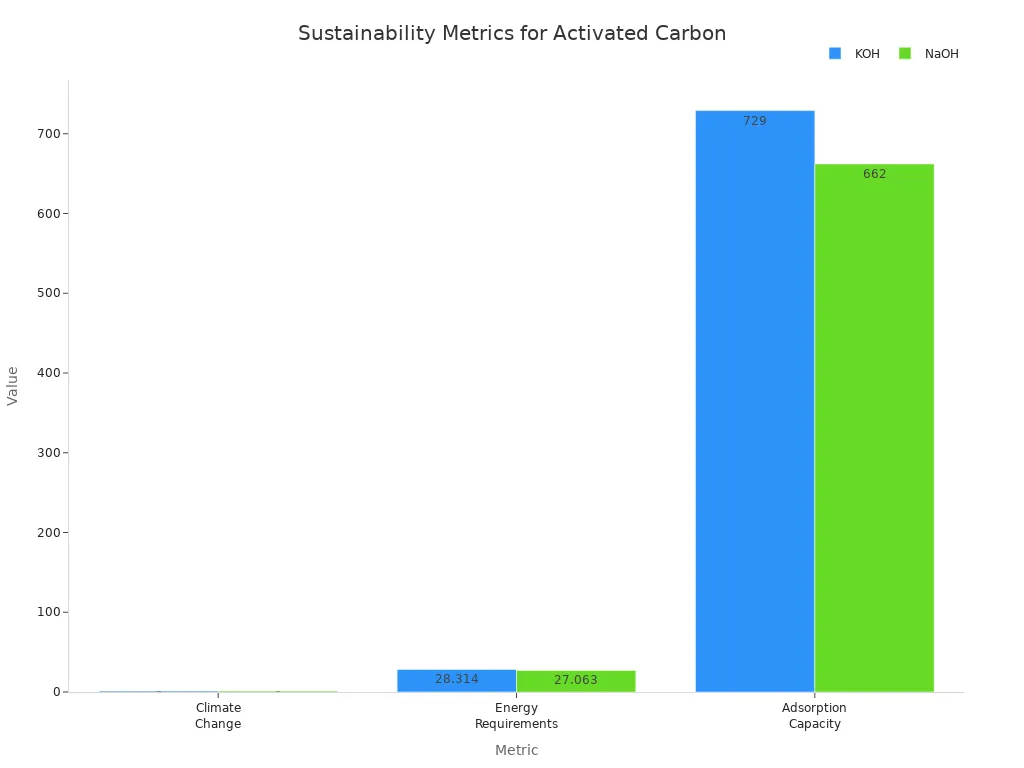
KOH-activated carbon can hold more pollutants. It uses energy better and makes less carbon emissions. These things help save energy and cut down on waste. If you use activated carbon from renewable materials, you help lower greenhouse gases.
Factories now use new ways to make activated carbon. Microwave and plasma activation use less energy. They also make more pores in the carbon. This means the carbon works better and cleans more. You help save resources and cut pollution.
Tip: Pick activated carbon made from renewable stuff and new methods. You help the earth and support green choices.
You can check sustainability by looking at climate change, energy use, and how much the carbon can hold. If you choose products with better numbers, you help the planet. You keep air and water clean and support a healthy world.
You also save money. Greener production uses less energy and makes less waste. You spend less and help stop pollution. You make good choices for your business and your town.
Callout: Sustainability is important. When you use impregnated activated carbon, you help make air cleaner, water safer, and the future greener.
Impregnated activated carbon helps take out bad things from air and water. It makes water treatment better, so water is safer and cleaner. Filters last longer and there are fewer bacteria in your water. Many companies now make special products and use greener ways to produce them. You will see more new ideas as more people want this and rules change.
Impregnated activated carbon lets you clean certain pollutants.
You get better results and can use it in many ways.
You help keep the earth safe and make industries safer.
Look for new ideas in impregnated activated carbon to find easier ways to clean and protect where you live and work.