
You deal with strong smells every day at home or work. Odors from bacteria, mold, or gas leaks can stay around and make places unpleasant. Bio odor control Activated Carbon is a strong way to fix this. It uses adsorption. Odor molecules stick to the carbon and get trapped. This means you do not just hide the smell. You remove it for good. See how well activated carbon gets rid of different odors:
Odorant Type | |
|---|---|
2-Methylisoborneol (2-MIB) | 83.5 – 97.5 |
β-Cyclocitral (β-cyclo) | 83.5 – 97.5 |
Butyl Sulfide (BS) | 83.5 – 97.5 |
Odors can come from many places. Here are some common ones:
Source of Odor | Description |
|---|---|
Agricultural Practices | Animal waste and fertilizer make strong ammonia smells. |
Food Processing | Meat plants often make ammonia smells. |
Wastewater Treatment | These plants can give off strong smells. |
Microorganisms | Bacteria and fungi break things down and release smells. |
Industrial Gas Leaks | Methane and hydrogen sulfide can make bad smells. |
You can trust activated carbon to fight each tough smell and make your space fresher.
Key Takeaways
Activated carbon gets rid of odors by trapping odor molecules. It does not just cover up smells. It works well on many odors, like pet smells, mold, and cooking odors. Pick activated carbon products with a large surface area for the best results. Check and change your activated carbon filters every 3 to 6 months. This helps them keep working well. Activated carbon is safe for homes with pets and kids. This makes it a good choice for families. Put carbon filters close to where odors start, like kitchens or litter boxes. This gives the best results. Activated carbon works better than regular air fresheners. It removes odors for a longer time. Use activated carbon with HEPA filters to make your home’s air even cleaner.
How Adsorption Powers Odor Control
If you want to stop bad smells, you need to know how activated carbon adsorption works. This process is not magic, but it can seem amazing when you see how well it removes odors. Let’s look at what happens when you use activated carbon for odor control.
Activated Carbon’s Surface Area
Activated carbon works because it has a huge surface area in each tiny piece. Imagine holding one gram of activated carbon. That small amount can have a surface area between 500 and 2000 square meters. That is like fitting many tennis courts into a sugar cube! The big surface area gives more places for odor molecules to stick. This helps control odors in your home or workplace.
Pore Structure and Odor Capture
The secret to strong odor control is in the pores of activated carbon. These pores are like millions of tiny traps. When you use activated carbon adsorption, here is what happens:
Odor molecules float in the air and touch the surface of activated carbon.
The molecules get pulled in and stick to the surface, like moths drawn to a light.
Once trapped inside the pores, the odor molecules stay there, so you do not smell them anymore.
A bigger surface area and good pore structure mean better odor control. For example, activated carbon with a BET surface area over 2000 m²/g can grab even more odor molecules. This makes your air fresher and cleaner.
Tip: For the best results, pick activated carbon products with high surface area and lots of pores. This gives you the strongest odor control.
Adsorption vs. Absorption
You might wonder if adsorption and absorption are the same. Both words sound alike, but they work differently for odor control. Here is a quick look:
Feature | Adsorption | Absorption |
|---|---|---|
Nature | Bulk phenomenon | |
Process | Molecules stick to a solid surface | Molecules soak into the material |
Examples | VOC removal using activated carbon | Water absorbed by a sponge |
Reusability | Often regenerable | Usually single-use |
With activated carbon adsorption, odor molecules stick to the surface. Absorption means the molecules soak into the whole material, like water in a sponge. For odor control, adsorption is faster and works better, especially for tough odors in the air.
Adsorption is a surface interaction, so it works quickly.
Absorption is a bulk process and can be slower.
Activated carbon adsorption gives fast odor control because the pores grab odor molecules right away.
Why Activated Carbon Adsorption Wins for Odor Control
You want the best odor control, so let’s see how activated carbon adsorption compares to other methods. Studies show adsorption can remove up to 93% of volatile organic compounds (VOCs), which are a big part of bio odors. Even advanced filters like biotrickling filters reach about 90% efficiency, but activated carbon adsorption often matches or beats that.
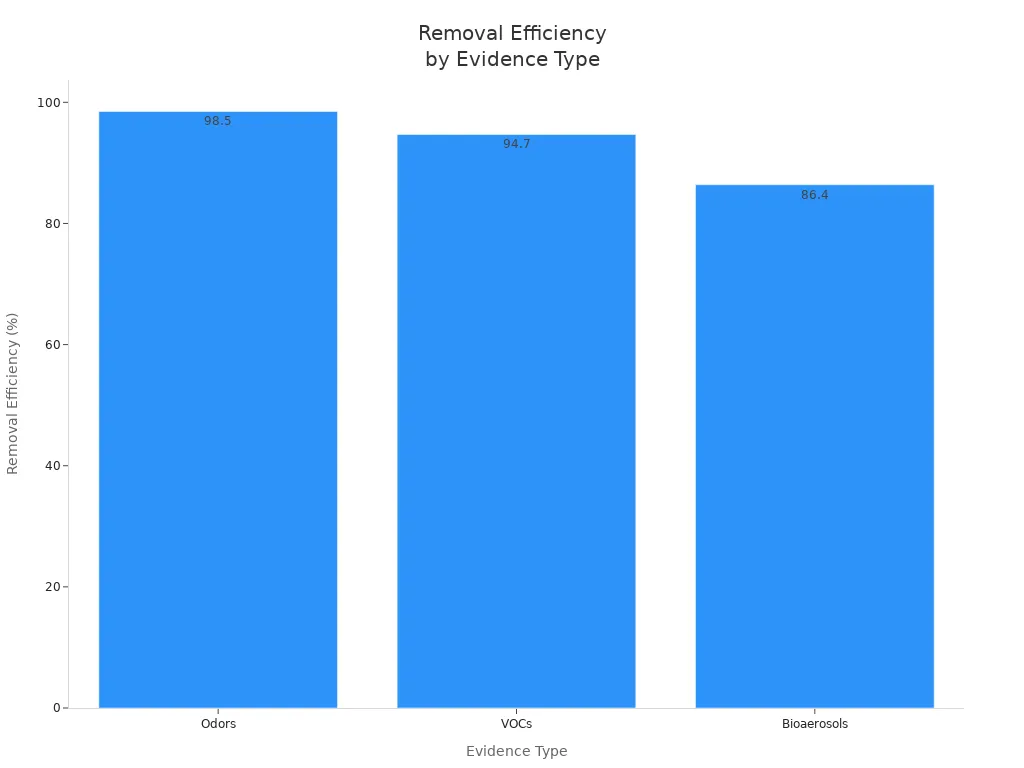
Activated carbon adsorption can remove up to 98.5% of odors.
It captures 94.7% of VOCs and 86.4% of bioaerosols.
Fast adsorption kinetics mean you get quick results.
The process is stable and works well even with tough odors.
If you want lasting odor control, activated carbon adsorption is your best choice. You get a solution that works fast, lasts long, and keeps your air fresh. You do not have to cover up smells anymore. Now you can remove them for good.
Bio Odor Control with Activated Carbon
Types of Bio Odors Removed
You might smell pets, mold, or food at home. These smells can stay and make your house feel less clean. Bio odor control activated carbon works to trap and remove these smells. You do not just hide the smell. You get rid of it for real.
Here are some smells that bio odor control activated carbon can target:
Moldy or musty smells from damp places
Cooking smells, like fried food or fish
Smoke smells from tobacco or fireplaces
Volatile organic compounds (VOCs) from cleaning products, paints, or furniture
Many things in your house can give off VOCs. These add more smells to your home. Bio odor control activated carbon grabs these molecules and keeps them inside. This helps your air stay clean and fresh.
Pet, Mold, and Food Odors
Pet smells can be strong. Litter boxes, cages, or bedding often smell bad. Mold grows in wet places and makes a musty smell. Cooking can leave food smells, especially after frying or baking. Biological odor control with activated carbon helps you fix all these problems.
Tip: Put bio odor control activated carbon near litter boxes, kitchens, or basements. You will see a big change in how your house smells.
Effectiveness in Different Environments
You can use bio odor control activated carbon almost anywhere. It works in homes, hospitals, and even big factories. Let’s look at how it works in different places:
Environment | Problem | Feasibility | Installation Areas | Constraints | Complementary Use |
|---|---|---|---|---|---|
Hospitals | Odors from disinfectants, waste, and biological materials | High | Operation theaters, waste rooms, ICUs | Must meet medical safety standards (no ozone leakage) | With HEPA filters and UV-C |
Homes | Cooking, pets, humidity-related odors | Moderate | Portable or wall-mounted units | Must comply with domestic ozone safety standards | May be relatively expensive for average households |
Industries | Strong odors from waste management and chemical processes | High | Industrial settings | Requires industrial-strength solutions | Activated carbon systems can capture up to 95% of airborne contaminants |
You get strong odor control in hospitals, where safety is very important. At home, you can use small units for biological odor control. In factories, bio odor control activated carbon fights tough smells from waste or chemicals.
Some things can change how well odor control works:
Airflow in the room
How strong the smell is
Humidity and temperature
The type of activated carbon used
You should check these things before you pick a system. Every place is different, so you want the best one for you.
Note: Activated carbon air filters have millions of tiny pores to trap smells. They work in many places, from homes to hospitals.
Bio odor control activated carbon gives you an easy way to fight smells. You can trust it to keep odors away, no matter where you use it.
Activated Carbon Filters for Odor Control
How Filters Work
You want your air and water to smell nice. Activated carbon filters help with this. These filters use adsorption. When air or water goes through, odor molecules stick to the carbon. The carbon has many tiny pores. These pores trap the odor so it cannot escape.
Here is how activated carbon filters help stop odors:
Air moves through the filter. Odor compounds get stuck in the carbon.
The carbon has a big surface area. This gives more spots for odor molecules to stick.
Odors like smoke, pet smells, and cooking fumes get pulled in by weak forces.
The trapped odor stays in the filter. Your air and water become cleaner.
New activated carbon filters have lots of empty pores. They can catch many types of odor. Over time, the pores fill up. You need to change the filter to keep it working well.
Tip: Check your filter every few months. If you smell odors again, it is time for a new filter.
Here is a quick look at how long activated carbon filters last in homes:
Lifespan Range | Description |
|---|---|
3 to 6 months | Most carbon filters last this long with normal use. |
Up to 18 months | Some high-quality filters last this long if used right. |
Up to 6 years | Some top air purifiers can last this long. |
Filter Applications in Homes and Industry
You can use activated carbon filters almost anywhere you need to stop odors. At home, you might use them in air purifiers, kitchen vents, or water pitchers. They remove odors from cooking, pets, and smoke. In water systems, they help get rid of bad tastes and smells.
In factories, odor control is very important. Factories, wastewater plants, and food centers all use activated carbon filters. These filters trap strong odors from chemicals, waste, and production lines. Here is a table showing where you might find these filters:
Application Area | Description |
|---|---|
Wastewater treatment | Used to treat odors in wastewater. |
Hydrogen sulfide and mercaptan removal | Removes certain harmful gases. |
Industrial air purification systems | Makes air better in factories. |
Odor control systems | Built just to manage odors. |
Rendering Plants | Controls odors in meat processing. |
Recycling | Helps with smells during recycling. |
Leather Manufacturing | Manages odors in leather making. |
Paper and Pulp | Controls odors in paper factories. |
Municipal Solid Waste | Manages smells from trash. |
Fertilizer Processing | Controls odors in fertilizer making. |
Cannabis/Grow Operations | Stops odors in cannabis growing. |
Food Processing | Manages smells from food products. |
In wastewater treatment, activated carbon filters are very important for odor control. They remove bad smells and even bad tastes from water. How well they work depends on how long the water touches the carbon, the type of carbon, and the temperature.
You can trust activated carbon filters for strong odor control at home or in big factories. They keep your air and water fresh, so you can breathe easy every day.
Neutralizing vs. Masking Odors
Lasting Odor Removal
You want your space to smell fresh, not just for a few minutes, but all day. That is where real odor control comes in. You might have tried sprays or scented candles. These products only cover up the odor. They do not get rid of it. When you use activated carbon, you get a different result. This material grabs odor molecules and holds them tight. It does not let them go back into the air.
Here is what makes neutralizing odors with activated carbon so effective:
Activated carbon adsorbs volatile organic compounds and terpenes. These are the main sources of many odors.
The process targets the odor at its source. It changes the shape of the odor molecules, so you cannot smell them anymore.
Neutralizing odors means you remove them at the molecular level. You do not just hide them.
You will notice that the air feels cleaner. The smell does not come back right away. That is because activated carbon keeps working until it fills up. When it does, you just replace it and keep enjoying fresh air.
Tip: For the best odor control, check your activated carbon filter often. Replace it when you start to notice odors again.
Limitations of Scented Products
You may see many products that promise to make your home smell better. Most of these use strong scents or perfumes. They try to mask the odor instead of removing it. This can lead to a mix of smells that is not always pleasant.
Let’s look at what happens when you use scented products for odor control:
Masking covers up odors with fragrances. This can create a more complex odor profile.
The original odor does not go away. It just hides under the new scent.
You need to keep spraying or lighting candles because the odor always comes back.
Sometimes, mixing scents with odors makes the air smell even worse.
You might think you fixed the problem, but you only covered it up. The odor stays in the room. You keep using more product, but the smell never really leaves.
Note: Masking agents only offer a temporary fix. They do not address the real cause of the odor. For lasting odor control, you need a solution that removes the odor, not just hides it.
If you want a home that smells truly clean, choose a method that neutralizes odors. Activated carbon gives you real odor control. You will not have to worry about bad smells coming back.
Wastewater Odor Control Systems

Activated Carbon in Water Treatment
Wastewater odor control systems help keep your neighborhood smelling nice. These systems use activated carbon to trap bad smells in water. Odors in wastewater come from hydrogen sulfide and organic compounds. Activated carbon is a strong tool for this job.
Most wastewater plants use two steps. First, they break down smelly stuff with biological methods. Next, they use activated carbon to catch leftover odors. The I-BOx® Biological Odor Control System is one example. It uses activated carbon after the first step. This catches any hydrogen sulfide and organic odors that are left. The air and water become cleaner for everyone.
Granular activated carbon (GAC) is common in these systems. You find GAC in filters and tanks. GAC grabs volatile organic compounds and hydrogen sulfide fast. It keeps odors from getting out. GAC works on many different smells. Wastewater plants trust it to keep the area safe and pleasant.
If you visit a wastewater plant, you will notice the air smells better near the carbon filters. Activated carbon does not just cover up odors. It removes them for good.
Removing Biogenetic Odorants
There are many biogenetic odorants in wastewater treatment. These come from bacteria, algae, and other living things. Wastewater odor control systems target these molecules to make air and water cleaner.
Activated carbon works well on common odorants. One tough odorant is methylisoborneol (MIB). MIB makes water smell earthy or musty. Wastewater odor control systems use activated carbon to remove MIB and other odorants. You can see how well this works in the table below:
Odorant | Mean Inlet Concentration (ng/L) | Removal Efficiency (%) |
|---|---|---|
Methylisoborneol (MIB) | 1 to 136 | 86.4%–100% |
You get high removal rates for MIB. This means your water smells and tastes better. Plants also target other odorants like geosmin and hydrogen sulfide. Activated carbon grabs these molecules and locks them away.
Here are some benefits of using activated carbon in wastewater odor control systems:
Cleaner air around the plant
Better tasting and smelling water
Fewer complaints from neighbors
Safer place for workers
You can see why these systems depend on activated carbon. It helps wastewater treatment work better. You get reliable odor removal and a healthier community.
Safety and Ease of Use
Non-Toxic for People and Pets
You want your home to be safe for everyone, including your pets. Activated carbon gives you peace of mind. You can use it around your family and animals without worry. Most products with activated carbon do not release harmful fumes or dust. They just sit quietly and do their job.
Here are some important things to know about safety:
The FDA does not check every non-drug health product before it goes on the market. Companies must make sure their products are safe and labeled the right way.
Activated charcoal is usually safe for pets. Vets sometimes use it to help animals who have eaten something bad. You should only use it for your pet if a vet says it is a good idea.
You do not need to worry about your kids or pets touching activated carbon filters in air purifiers or odor control systems. They do not leak dangerous chemicals.
Tip: Always follow the instructions on the package. If you use activated carbon for a special reason, like in an aquarium or for a sick pet, ask an expert first.
You can trust activated carbon to help control emissions and keep your air clean. It works without adding new risks to your home.
Simple Setup and Maintenance
You do not need special skills to use activated carbon products. Most filters and odor control units come ready to use. You just place them where you need them. They start working right away to trap odor-causing chemicals.
To keep your system working well, follow these easy steps:
Keep your air or water system running. This helps the carbon keep catching odors and stops gases from building up.
Change the carbon media on time. Check your filter every few months. If you notice smells coming back, it is time for a new one.
Watch for big changes in your home or business. If you start cooking more, get a new pet, or change how you use a room, you might need to check your filters more often.
Pick the right kind of activated carbon for your needs. Some types work better for certain smells.
Think about the seasons. Hot or humid weather can make odors stronger. You might need to check your filters more often in summer.
Note: Good maintenance means your activated carbon keeps working its best. You get fresh air and fewer worries.
You can set up and care for activated carbon products with little effort. You do not need fancy tools or training. Just follow the steps, and you will enjoy a cleaner, safer space.
Practical Tips for Home Odor Control
Choosing Activated Carbon Products
You want your home to smell fresh and clean. Picking the right carbon filter makes a big difference. You do not need to feel lost when you shop. Here are some things you should look for:
Check if the carbon filter has certifications from groups like NSF or WQA. These show the product meets high standards.
Think about what odors you want to remove. Is it pet smells, cooking, or musty air? Some carbon filters work better for certain odors.
Look at the type of activated carbon. Some are made for air, others for water. Pick the one that fits your needs.
Match the pore size of the carbon filter to the size of the odor molecules you want to trap. This helps the filter work better.
Make sure the carbon filter fits your air purifier or vent. You want a good fit for the best results.
Try a small carbon filter first if you are not sure. You can see how well it works before you buy more.
Tip: You can ask the store or check the box for performance standards. Certifications are helpful, but you should also think about your own needs.
You may also want to think about the conditions in your home. If you have high humidity or heat, pick a carbon filter that works well in those settings. This helps you get the most out of your filter.
Here is a quick table to help you compare:
Feature | What to Check |
|---|---|
Certification | NSF, WQA, or other trusted groups |
Odor Target | Pet, food, mold, smoke, VOCs |
Type | Air or water carbon filter |
Pore Size | Matches odor molecule size |
Fit | Fits your device or vent |
Trial | Try a small one first |
You can use a carbon filter in many places. Some people use them in air purifiers, kitchen vents, or even in the fridge. Biofiltration systems often use a carbon filter to trap tough odors. You get better results when you match the filter to your problem.
Placement and Replacement
You want your carbon filter to work its best. Where you put it matters. Place your carbon filter close to the source of the smell. For example, put one near the litter box, trash can, or kitchen vent. If you use a carbon filter in your air purifier, keep the purifier in the room where you notice the most odors.
Biofiltration works well when you use the right placement. You can use a carbon filter in your bathroom, basement, or laundry room. Some people even put a small carbon filter in their shoes or gym bag to reduce odors.
You should also know when to change your carbon filter. Most people need to replace their carbon filter every 3 to 6 months. Some homes with strong smells may need a new carbon filter every month. Always check the instructions from the maker. If you start to smell odors again, it is time for a new carbon filter.
Here is a simple checklist for you:
Place your carbon filter near the odor source.
Check your carbon filter every month.
Replace your carbon filter every 3 to 6 months.
Change your carbon filter sooner if you notice smells coming back.
Keep extra carbon filters on hand for easy swaps.
Note: A fresh carbon filter works better. Old filters fill up and cannot trap more odors. Regular replacement keeps your home smelling good.
Biofiltration with a carbon filter is easy to set up and maintain. You do not need special tools. You just swap out the old carbon filter for a new one. This simple step helps you reduce odors and keep your air fresh.
You can trust a carbon filter to help with many smells. Biofiltration uses a carbon filter to trap odor molecules and keep them from coming back. You get a cleaner, fresher home with less effort.
You want a home that smells clean and feels fresh. Activated carbon makes that possible. Here’s why you should choose it:
It absorbs odors, not just covers them up.
It works well in kitchens, bathrooms, and damp spaces.
It’s safe for your family and pets.
You can use it easily without special tools.
Why Activated Carbon Wins | What It Does |
|---|---|
Removes tough odors | Grabs VOCs, chlorine, and chemicals |
Lasts longer | Outperforms sprays and scented products |
Improves air quality | Leaves no fake scents behind |
Try activated carbon filters in your home. Replace them often and pair with HEPA filters for even better results. You’ll breathe easier every day.